Azelaic Acid Is the Brightening Active You’re Probably Underusing — Here’s the Formulation Evidence
You’ve probably already heard of vitamin C serums and niacinamide for dark spots. Those are solid options — and this site has covered them at length. But there’s a third brightening ingredient that shows up in prescription formulas and clinical research just as often, costs a fraction of what many prestige actives cost per effective dose, and is notably easier to layer with almost everything else in your routine. It’s called azelaic acid. It’s a naturally occurring dicarboxylic acid — meaning a type of organic acid — derived originally from grain fermentation, now synthesized for cosmetic and pharmaceutical use. It works by interrupting the process your skin uses to produce excess pigment, without the instability issues that make vitamin C formulas tricky to store. If you’ve been sleeping on this ingredient, this article will walk you through the concentration thresholds that matter, the clinical evidence behind the claims, and exactly how to work it into a brightening protocol.
| EDITOR'S PICK[Allies of Skin Azelaic & Kojic…](https://www.amazon.com/dp/B0DWX2YTPM?tag=greenflower20-20) | Mid-tier[The Ordinary Azelaic Acid Suspe…](https://www.amazon.com/dp/B06WD5J8KY?tag=greenflower20-20) | Budget pick[Good Molecules 10% Azelaic Acid…](https://www.amazon.com/dp/B0FZPGQHFB?tag=greenflower20-20) | |
|---|---|---|---|
| Additional Actives | ✓ | ✗ | ✗ |
| Targets Acne | ✓ | — | — |
| Targets Redness | ✓ | — | ✓ |
| Texture | Serum | Suspension | Treatment |
| Vegan | — | — | ✓ |
| Price | $99.00 | $12.20 | $11.99 |
| See on Amazon → | See on Amazon → | See on Amazon → |
What the Research Actually Shows
Let’s start with the mechanism, because it explains why azelaic acid behaves differently from its peers. Most brightening actives work through a single pathway. Vitamin C (L-ascorbic acid) is primarily an antioxidant that also inhibits tyrosinase — the enzyme responsible for triggering melanin production, which is the pigment that creates dark spots. Kojic acid is also a tyrosinase inhibitor. Tranexamic acid works mainly by blocking a different signal pathway between UV-damaged skin cells and melanocytes (the cells that produce pigment).
Azelaic acid does several things simultaneously. It inhibits tyrosinase. It also preferentially targets overactive or abnormal melanocytes — the cells producing excess pigment — while leaving normally functioning melanocytes largely alone. This selectivity is a meaningful clinical differentiator. It means azelaic acid is less likely than hydroquinone (a powerful but controversial skin-lightening ingredient) to cause unwanted lightening of surrounding skin. It also has documented anti-inflammatory effects, which matters because post-inflammatory hyperpigmentation — dark marks left after acne, eczema flares, or any skin trauma — has an inflammation component that pure tyrosinase inhibitors don’t address.
The landmark study practitioners most often cite: a 1991 trial published in the International Journal of Dermatology by Baliña and Graupe compared 20% azelaic acid cream to 4% hydroquinone — then considered the gold-standard prescription brightener — in melasma patients (melasma is a form of chronic, hormonally driven hyperpigmentation). The 20% azelaic acid arm showed comparable efficacy to hydroquinone at 24 weeks, with a significantly lower side-effect profile. That result has shaped how dermatologists think about azelaic acid ever since.
A comprehensive pharmacological review published in Drugs (Fitton and Goa, 1991, indexed on PubMed) confirmed the dual mechanism and the tolerability advantage, noting that azelaic acid doesn’t carry the systemic risks associated with long-term hydroquinone use. Paula’s Choice’s Ingredient Dictionary entry on azelaic acid cites this body of research and gives the ingredient a “best” efficacy rating for uneven skin tone and dark spots — one of the fewer brighteners to earn that top-tier designation in their database.
Concentration Thresholds: Where the Effective Dose Starts
This is the number most product labels obscure. Here’s what the research supports:
By the numbers:
- 15–20%: Prescription / clinical strength — the concentration range studied in the Baliña/Graupe melasma trial; requires monitoring in some markets
- 10–15%: Meaningful OTC brightening effect; documented efficacy on post-inflammatory hyperpigmentation
- 5–9%: Sub-clinical for dark-spot correction alone, though still useful in combination formulas for texture and tone
- <5%: Largely a marketing presence; unlikely to move pigment meaningfully on its own
The practical implication: if a product lists azelaic acid without disclosing the percentage, that omission is a flag. At concentrations below 10%, you’re probably not getting the brightening payoff the label implies. Brands that are confident in their dose — like Naturium’s Azelaic Acid Emulsion 10% and Paula’s Choice’s 10% Azelaic Acid Booster — publish the number prominently. That transparency is itself a signal.
For practitioners sourcing products for clients, the prescription-only 20% azelaic acid gel (Finacea and its generics in the US) remains the clinical benchmark. For retail-facing recommendations, 10% is the effective floor. Anything in the 15–20% OTC range (some EU-marketed products reach this concentration over the counter) offers the strongest non-prescription evidence base.
Healthline’s overview of azelaic acid reinforces this threshold framework, noting that 15–20% concentrations are where the majority of peer-reviewed evidence sits, while OTC formulas in the 10–15% range are generally well-tolerated with consistent use.
Layering Logic: What Azelaic Acid Can (and Cannot) Work With
This is where azelaic acid’s real competitive advantage shows up. Compared to the layering constraints on vitamin C — which conflicts with certain pH-sensitive actives and degrades under light and air — azelaic acid is genuinely low-maintenance.
Compatible with:
- Niacinamide: One of the most synergistic pairings in brightening. Niacinamide (vitamin B3) suppresses the transfer of melanin from melanocytes to skin surface cells; azelaic acid suppresses melanin production upstream. They operate on different parts of the same pathway. Reviewed together in Byrdie’s ingredient-pairing guides as a recommended combination.
- Tranexamic acid: No documented antagonism. Both can be used in the same routine step or in morning/evening split; together they cover three separate mechanisms of hyperpigmentation. Good Molecules’ Discoloration Correcting Serum (which uses tranexamic acid as its primary active) is frequently recommended alongside a separate azelaic acid product for this reason.
- SPF / physical sunscreen: Azelaic acid doesn’t sensitize skin to UV the way glycolic acid and retinoids do. It doesn’t require morning-only or evening-only scheduling. That said, SPF remains non-negotiable in any brightening protocol — without UV protection, no topical active can reliably prevent dark spots from reforming.
- Retinoids (retinol / retinal / tretinoin): Usable in the same routine but best on alternating days if your skin is new to one or both. The combination can be effective but irritation stacks if introduced simultaneously. Vogue Beauty’s 2025 roundup of underrated brighteners noted dermatologists frequently recommend azelaic acid as a retinoid companion specifically because its anti-inflammatory properties can buffer some of the redness retinoids produce.
Be thoughtful with:
- High-concentration exfoliating acids (AHAs/BHAs above 5%): Not incompatible, but layering two acid-class actives in the same step can tip sensitive skin into irritation. If you’re using a 15% glycolic toner or a 2% BHA exfoliant, use azelaic acid at a different time of day rather than directly after.
- Prescription-strength vitamin C (L-ascorbic acid at 15–20%): Both are technically acid-class; both can increase skin sensitivity in high concentrations. At prescription azelaic acid doses, give each its own routine slot.
The practical split that works well for most brightening protocols: azelaic acid in the AM (after cleansing, before SPF), tranexamic acid or niacinamide PM serum, retinoid on alternating evenings. This covers multiple pigmentation pathways across the week without stacking irritation risk.
Where It Sits on the Price-to-Efficacy Map
Azelaic acid is one of the more cost-favorable actives at the effective concentration threshold. Here’s the honest comparison:
SkinCeuticals C E Ferulic ($182 for 30ml) delivers a well-studied 15% L-ascorbic acid formula with ferulic acid synergy — the clinical case for that combination is strong, but the price reflects proprietary stabilization chemistry and brand positioning. Murad Rapid Age Spot Correcting Serum ($82) leads with hydroquinone and tranexamic acid, which is effective but requires cycling off hydroquinone periodically. Good Molecules Discoloration Correcting Serum (~$12) is a genuinely strong entry-level tranexamic acid option.
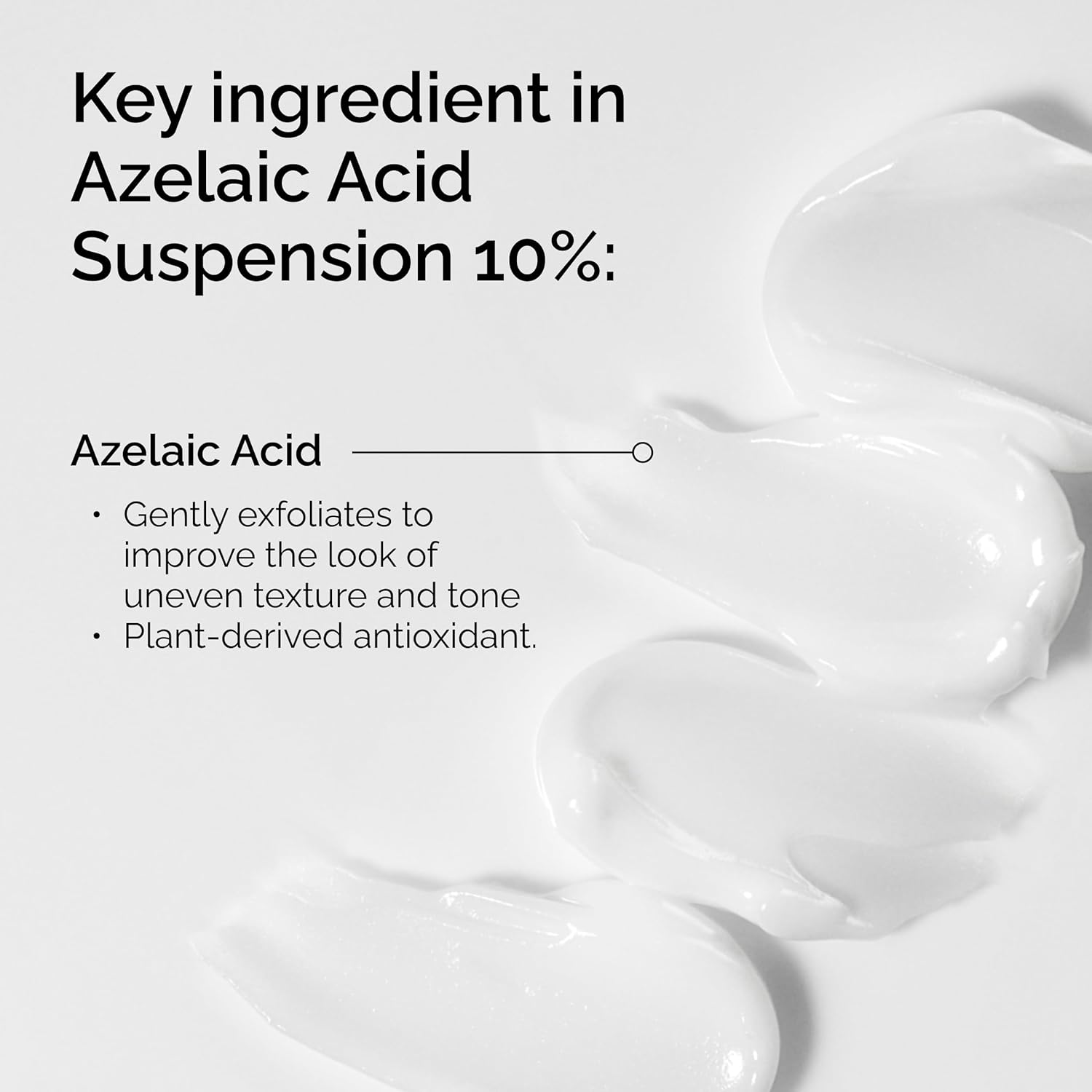
A well-formulated 10% azelaic acid product — Naturium’s, Paula’s Choice’s, or The Ordinary’s 10% Azelaic Acid Suspension — lands in the $8–$30 range. At that price point, you’re getting a concentration with documented clinical evidence, no counterfeiting risk (these are widely available at major authorized retail channels including Sephora, Target, and brand DTC sites), and a layering-friendly profile that reduces the need to audit your entire routine around it.
The honest tradeoff: azelaic acid works more gradually than hydroquinone and less dramatically on deep, established melasma than prescription-strength retinoids plus HQ. If a client has severe, chronic melasma, the Baliña/Graupe data shows 20% azelaic acid is competitive with hydroquinone — but that’s the prescription-strength study, not the 10% OTC version. Manage expectations accordingly.
The Decision Rule
If you’re building or recommending a brightening protocol and the primary concern is:
- Post-inflammatory hyperpigmentation (acne marks, eczema scars): Azelaic acid is a strong first-line choice. The anti-inflammatory mechanism directly addresses the root cause. A 10%+ OTC formula is a reasonable starting point.
- Early or mild sun-damage dark spots: Azelaic acid plus daily SPF 50 is well-supported by the evidence. Add niacinamide for synergy.
- Melasma, moderate-to-severe: The clinical data supports 20% prescription azelaic acid as an alternative to hydroquinone. OTC 10% may not be sufficient alone — consider stacking with tranexamic acid and referring to a prescriber for the 20% option.
- Sensitivity concerns with other actives: If a client can’t tolerate high-concentration vitamin C or retinoids, azelaic acid is often the path of least resistance. Breathnach’s Cutis review noted its tolerability advantage specifically for reactive skin types.
- Routine simplification: If someone is already using a well-formulated vitamin C in the morning, azelaic acid in PM is a clean, compatible add — no pH timing gymnastics required.
The bottom line is that azelaic acid’s evidence base is stronger than its cultural profile suggests. The ingredient has been in peer-reviewed trials since the early 1990s, has a clear effective concentration threshold, layers cleanly with most of the brightening toolkit, and carries a price-to-formulation ratio that’s hard to argue with at any budget tier. The main reason it’s underused is simply that it doesn’t have the marketing muscle of vitamin C. That’s a positioning gap, not a clinical one.