Body Hyperpigmentation Treatments: The Actives That Work Below the Neck and How to Use Them Safely
You’ve probably heard a lot about fading dark spots on your face — vitamin C serums, niacinamide, retinol. But what about the patches of uneven, darker skin that show up on your elbows, knees, inner thighs, underarms, or the backs of your hands? That’s body hyperpigmentation: areas where the skin produces more melanin (the pigment that gives skin its color) than surrounding tissue, creating spots or patches that look darker. It happens because of sun exposure, friction, old acne scars, hormonal shifts, or just genetics. The good news is that the same class of ingredients that brighten your face can absolutely work below the neck. The catch is that body skin is structurally different — thicker, less vascularized, slower to turn over — which means the protocol has to adapt. This article lays out which actives are worth using, what concentrations to look for, and how to layer them without getting into trouble.
Why Body Skin Plays by Different Rules
If you’ve ever applied a face serum to a dark elbow and seen nothing happen, this section explains why.
Body skin — especially on knees, elbows, and inner thighs — has a significantly thicker stratum corneum (the outermost layer of skin that acts as a barrier). Per a review published in the journal Cosmetics and Toiletries, transdermal penetration of actives is meaningfully lower on areas with a dense keratinized layer. That matters because ingredients like L-ascorbic acid (vitamin C) and tranexamic acid depend on reaching the basal layer of the epidermis, where melanin is actually produced. If they can’t get there, they don’t work.
The practical implication: body brightening requires either higher concentrations, enhanced delivery vehicles (glycols, penetration enhancers like propylene glycol or niacinamide itself), or physical exfoliation to thin the stratum corneum before an active is applied. Usually some combination of all three.
Body skin also has fewer sebaceous glands, which means it’s drier, more prone to barrier disruption, and less able to self-repair after aggressive exfoliation. That dryness matters when you’re layering acids.
By the numbers:
- Stratum corneum thickness on the face: ~15–20 cell layers
- Stratum corneum thickness on the back/thighs: ~20–30 cell layers (per published comparative anatomy data via PubMed)
- Typical AHA penetration reduction on thick-skinned body sites: estimated 30–50% lower than facial equivalents at equal concentration
The Active Stack: What Works, What to Expect, and What to Skip
Here’s the decision-layer breakdown for the five actives with the strongest evidence base for body use.
Alpha Hydroxy Acids (AHAs) — Your Non-Negotiable First Step
Glycolic acid and lactic acid are the workhorses for body hyperpigmentation, and they’re doing two jobs simultaneously: exfoliating the surface layer so other actives can penetrate, and directly inhibiting melanin transfer over time. A PubMed review of AHAs in cosmetic dermatology (PMID 26948863) confirms their role in improving skin texture and pigmentation at concentrations of 5–15% with regular use.
For body application, glycolic acid at 10–15% is the functional minimum. Below 5%, you’re moisturizing, not treating. Products in this range include L’Oréal Glycolic Bright body lotion (widely reviewed by Byrdie and Allure as a strong entry-level option in the $10–$15 range) and Neutrogena Rapid Tone Repair, which uses both glycolic and retinol.
Lactic acid is a better call for dryer body skin areas — inner thighs, underarms — because it has humectant properties alongside its exfoliating action. Look for 10% minimum. AmLactin’s 12% lactic acid formulation is consistently cited across Healthline and Byrdie as one of the most evidence-supported drugstore body brightening options available.
Tradeoff to name explicitly: AHAs thin the stratum corneum, which temporarily reduces UV protection. Body areas that get sun exposure — forearms, décolleté, shoulders — require SPF application over any AHA treatment during the day, or night-only use. Non-negotiable. Skipping SPF during AHA treatment on sun-exposed body areas is how you create new hyperpigmentation while treating old.
Niacinamide — The Tolerance-Builder and Brightener
Niacinamide (vitamin B3) works upstream in the melanin pathway by inhibiting the transfer of melanosomes from melanocytes to keratinocytes — effectively slowing how dark pigment gets distributed into skin cells. A landmark study published in the British Journal of Dermatology (PMID 16029679) demonstrated statistically significant improvement in hyperpigmentation with 5% niacinamide over 8 weeks.
For body use, 5% is the established minimum effective dose. 10% is used in some prestige formulations and may offer faster visible results. Niacinamide also supports barrier function, which makes it particularly valuable for body areas prone to dryness and irritation — think underarms post-waxing, or inner thighs with friction hyperpigmentation.
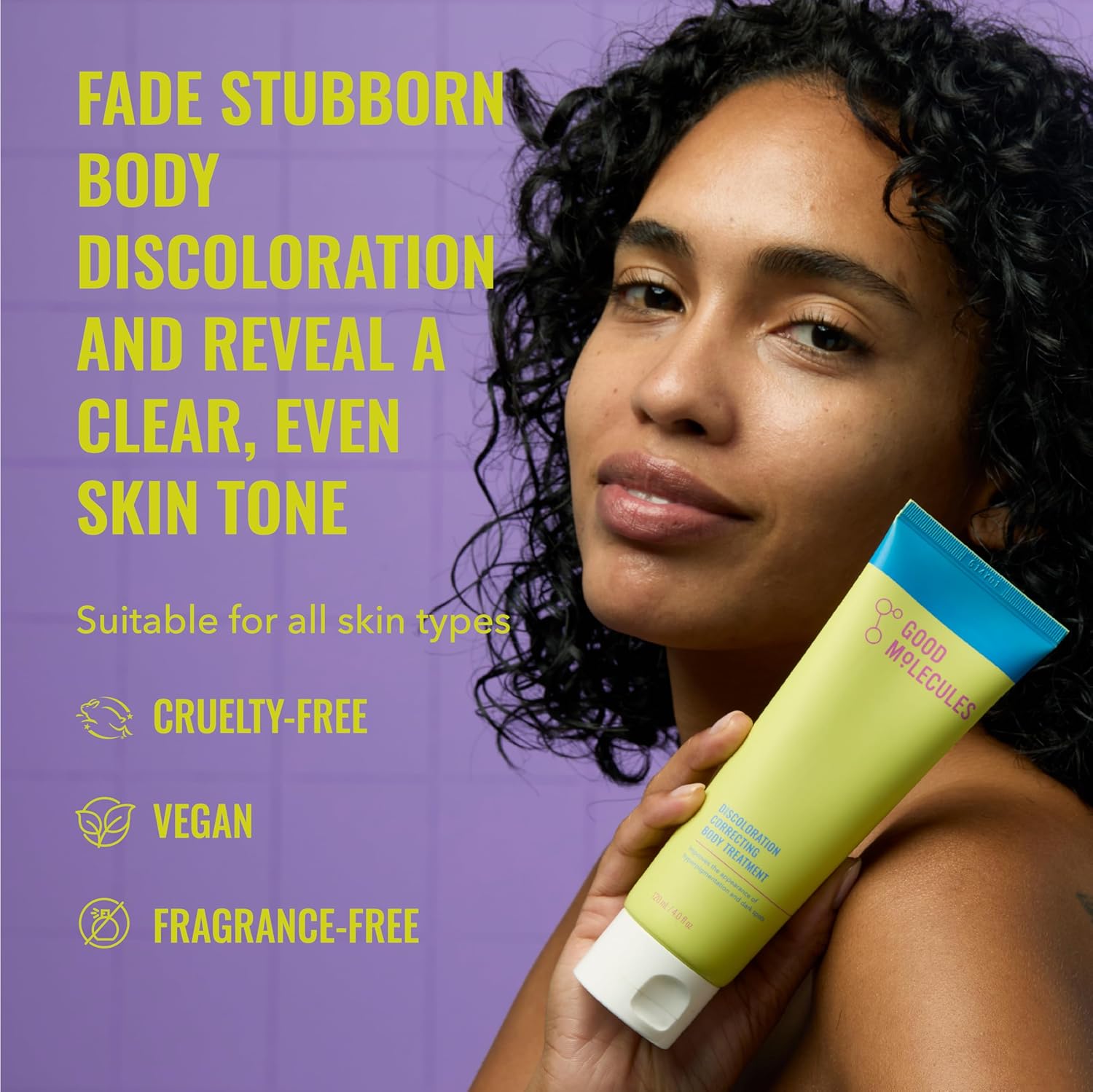
At the mid-tier, Good Molecules Discoloration Correcting Serum leads with 5% tranexamic acid and pairs well with a niacinamide body product layered after. Paula’s Choice Niacinamide Booster (20% — though clinical evidence for body skin above 10% is not yet robust) is a strong pick for advanced users who want concentrated spot treatment on specific patches.
Layering note: Niacinamide is one of the most compatible actives in the brightening stack. It pairs cleanly with AHAs, tranexamic acid, kojic acid, and vitamin C. The old concern about niacinamide + vitamin C producing niacin and flushing has been largely debunked in the literature at real-world formulation ratios (per Paula’s Choice Ingredient Dictionary). It is not a barrier to combining them.
Tranexamic Acid — The Underrated Mid-Stack Anchor
Tranexamic acid (TXA) is the active ingredient most practitioners underestimate at the body level. Originally a hemostatic pharmaceutical, it was found to inhibit plasminogen activator in keratinocytes — which ultimately reduces UV-induced melanogenesis. A randomized, double-blind trial (PubMed PMID 26436977) showed meaningful lightening of melasma with 3% topical tranexamic acid versus placebo.
For body hyperpigmentation — particularly post-inflammatory hyperpigmentation (PIH) from acne, folliculitis, or friction — TXA is compelling because it tolerates compromised skin barriers better than AHAs and doesn’t carry the sun-sensitizing risk. That makes it the better call for inner thighs, buttocks, and underarms: areas that rarely get daily SPF application.
Minimum effective concentration: 2–3% topical. The Good Molecules Discoloration Correcting Serum sits at 5% TXA and is mid-tier priced (approximately $12–$16 at authorized retailers). SkinCeuticals Discoloration Defense ($98) uses tranexamic acid alongside kojic acid and niacinamide — a clinical-grade combination that represents the ceiling of evidence-backed formulation in this category.
If X, then Y: If the hyperpigmentation is in a high-friction zone or an area that never sees SPF, prioritize TXA over AHAs as the lead active. If it’s on sun-exposed body skin (forearms, chest, shoulders), run AHAs at night with SPF during the day, and add TXA as the daytime treatment.
Kojic Acid — High-Efficacy, Handle with Care
Kojic acid inhibits tyrosinase, the enzyme responsible for melanin synthesis. Per the Paula’s Choice Ingredient Dictionary, it’s one of the few ingredients with direct enzyme-inhibition evidence comparable to the prescription-only hydroquinone. Clinical concentrations range from 1–4%.
The practical issue with kojic acid on body skin is sensitization. Kojic acid is a known allergen at higher concentrations and can cause contact dermatitis, particularly under occlusion (think: clothing rubbing against treated skin). For body use, stay at 1–2%, introduce slowly, and avoid it on abraded or actively irritated skin.
At the prestige tier, SkinCeuticals and Murad both incorporate kojic acid alongside other brightening actives. Murad Rapid Age Spot Correcting Serum ($82) combines kojic acid with glycolic acid — a logical pairing (exfoliant + tyrosinase inhibitor) that multiple dermatology-facing publications, including Allure’s brightening guides, have flagged as an efficient two-mechanism stack.
Layering caution: Kojic acid + AHAs at high concentrations is a sensitization risk on body skin. If you’re using a glycolic body lotion daily, spot-treat with a kojic product rather than applying both all-over simultaneously until tolerance is established.
Vitamin C (L-Ascorbic Acid) — Face Logic Doesn’t Fully Translate
L-ascorbic acid (LAA) is the gold standard for facial brightening. At 10–20%, with pH 3.5 or below, it’s the most evidence-dense antioxidant brightener in the literature. SkinCeuticals C E Ferulic ($182) is the benchmark formulation.
The body-specific issue: LAA at low pH is irritating and unstable. Applied to large body surface areas — especially over abraded or dry skin — it can cause stinging, redness, and barrier disruption. It also needs to be absorbed before clothing contact, which makes routine body application impractical.
The smarter move is vitamin C derivative formats — ascorbyl glucoside, sodium ascorbyl phosphate, ascorbyl tetraisopalmitate — which are more stable, less irritating, and better suited to the body application context. These derivatives are less potent than LAA at equivalent concentration, but they’re deliverable in a body lotion format with realistic daily compliance.
Decision rule: Reserve L-ascorbic acid serums for spot treatment on specific patches (backs of hands, décolleté) where you can apply carefully and wait before dressing. For broad-area body use, vitamin C derivatives in a lotion base are the realistic, effective choice.
Building a Body Brightening Protocol That Actually Gets Used
The most sophisticated active stack fails if it sits on the shelf. Body brightening requires consistent, large-area application — which means the formulation format matters as much as the ingredient.
A practical 3-step structure that practitioners consistently recommend (per formulation reviews at Byrdie and Dermstore’s editorial blog):
- Exfoliate 2–3x per week with an AHA body wash or lotion (10–15% glycolic or 12% lactic acid). This is the penetration primer for everything else.
- Apply a leave-on brightening active daily — tranexamic acid or niacinamide in a lotion format for broad areas; kojic acid or vitamin C derivatives for spot treatment.
- SPF 30+ on any sun-exposed body area every morning, non-negotiable when using AHAs.
Visible results on body hyperpigmentation run 8–16 weeks minimum. Body skin turns over more slowly than facial skin. Set that expectation clearly — with clients if you’re a practitioner, with yourself if you’re building your own protocol.
The If-Then Decision Frame
- If budget is the primary constraint: 12% lactic acid body lotion (AmLactin tier) + SPF. This two-product stack has the strongest efficacy-to-cost ratio in the category.
- If the area won’t reliably get SPF: Lead with tranexamic acid, not AHAs. Good Molecules Discoloration Correcting Serum is the mid-tier value leader here.
- If you’re treating a client with sensitive or barrier-compromised skin: Niacinamide first to rebuild tolerance, introduce TXA at week 4, introduce AHAs at week 8.
- If you want the most evidence-dense prestige formulation: SkinCeuticals Discoloration Defense for the active combination; run it alongside a lactic acid body lotion for penetration support.
- If sun-exposed areas are the primary concern (chest, forearms, décolleté): AHA at night + vitamin C derivative in the morning + SPF. That’s the facial-logic protocol adapted for body skin, and it’s what the evidence supports.
Body brightening isn’t a different category than face brightening. It’s the same category with a thicker barrier, lower natural exfoliation rate, and a compliance problem. Solve for those three things, and the actives work.