Budget Brightening Serums Under $15: A Formulation Audit of What’s Actually Worth Buying
Dark spots — the flat, brownish patches left behind by sun exposure, acne, or hormonal shifts — are one of the most common skin concerns people bring to dermatologists and aestheticians. “Brightening” is the skincare category built around fading them. It covers a wide range of ingredients, from vitamin C (technically called L-ascorbic acid) to niacinamide (a form of vitamin B3) to kojic acid (a byproduct of fermentation) and newer molecules like tranexamic acid. These ingredients work by interrupting the skin’s melanin-production process — melanin being the pigment that causes those spots to appear darker than the surrounding skin. The good news for anyone just starting out: you do not have to spend $100 to get a formulation with real clinical backing. The complicated news: you do have to know what to look for on a label. This guide does that work for you.
If you already know your niacinamide from your alpha-arbutin, this is your practical audit. The question here isn’t “do budget brighteners work in theory?” — the published evidence says some of them absolutely do. The question is which sub-$15 products are actually formulated to cross the minimum effective concentration thresholds that the clinical literature defines, and which are trading on ingredient marketing without the percentages to back it up. Let’s work through the math.
| EDITOR'S PICK[The Ordinary Ascorbyl Glucoside…](https://www.amazon.com/dp/B074NNVLCM?tag=greenflower20-20) | Mid-tier[The Ordinary Alpha Arbutin 2% +…](https://www.amazon.com/dp/B0DN6RDJ2H?tag=greenflower20-20) | Budget pick[The Ordinary Niacinamide 10% +…](https://www.amazon.com/dp/B0DDQ4MSXS?tag=greenflower20-20) | |
|---|---|---|---|
| Key active | Ascorbyl Glucoside 12% | Alpha Arbutin 2% + HA | Niacinamide 10% + Zinc 1% |
| Target concern | Even skin tone | Dark spots | Blemish-prone skin |
| Texture | Solution | — | — |
| Price | $14.80 | $11.50 | $6.00 |
| See on Amazon → | See on Amazon → | See on Amazon → |
The Minimum Effective Concentration Problem (And Why It Decides Everything)
Every brightening active has a floor. Below a certain concentration in the finished formula, the ingredient is present — technically — but not doing meaningful work on melanin suppression. Understanding those floors is the entire game when auditing budget products, because cost pressure almost always gets absorbed at the formulation level first.
Here are the thresholds that matter, drawn from peer-reviewed literature:
By the numbers
| Active | Minimum Effective % | Notes |
|---|---|---|
| Niacinamide | 2–5% | 5% studied most robustly; Hakozaki et al., 2002 |
| Kojic acid | 1–2% | Oxidation instability limits higher use; Peng et al., 2020 |
| Tranexamic acid (topical) | 2–3% | Tierney 2021 puts 3% as clinical benchmark |
| Alpha-arbutin | 1–2% | Higher is better; instability at elevated pH |
| Ascorbic acid (Vitamin C) | 10–20% | Degrades quickly; pH and packaging are critical |
This table is the lens for every product discussion below. When a brand lists an active in their marketing headline but positions it late in the ingredient list — behind fragrance, behind multiple thickeners — the concentration is almost certainly sub-clinical. That’s not speculation; it’s how cosmetic ingredient-list ordering (required by the FDA to go from highest to lowest concentration) works in practice.
Paula’s Choice’s Ingredient Dictionary notes exactly this dynamic for niacinamide: the ingredient is well-tolerated and effective, but the concentration in the formula is what separates a placebo-tier product from a clinically relevant one.
Which Budget Actives Are Clinically Supportable Under $15
Niacinamide: The Most Defensible Budget Active
Niacinamide is the most stable, most forgiving, and most cost-efficient brightening active available. It inhibits melanosome transfer — the process by which pigment granules move from melanocytes into surrounding skin cells — without the pH sensitivity of vitamin C or the potential for oxidative damage of kojic acid. At 5%, the effects on uneven pigmentation and post-inflammatory hyperpigmentation (the dark marks left after breakouts) are clinically documented. Healthline’s overview of niacinamide for skin notes its dual role in brightening and barrier support, which matters because many people with dark spots also have compromised barriers from over-exfoliating.
The ingredient is inexpensive to source, which means a formulator has little financial incentive to skimp. A budget brand that leads with niacinamide — with it appearing in the first five ingredients — is very likely meeting that 5% threshold.
Products to evaluate in this space: The L’Oréal Glycolic Bright line lands at or under $15 at most mass retailers and lists glycolic acid (an exfoliating alpha-hydroxy acid that accelerates surface-cell turnover, making it easier for brighteners to penetrate) prominently alongside niacinamide. The combination is formulation-smart: exfoliation improves the delivery environment for pigment-targeting actives.
Neutrogena’s Rapid Tone Repair franchise sits at the $15–$18 boundary depending on retailer, and while it pushes slightly above this article’s price ceiling at some outlets, reviewers at Byrdie consistently include it in accessible-tier brightening roundups for its retinol-plus-vitamin C positioning. Worth monitoring for sale pricing.
Kojic Acid: Real Efficacy, Real Instability Risk
Kojic acid works. Peng et al.’s 2020 research published in the Journal of Cosmetic Science confirmed its melanogenesis-inhibiting mechanism, and at 1–2% it produces measurable results over 4–8 weeks. The issue — particularly relevant in the budget tier — is stability. Kojic acid oxidizes when exposed to light and air, turning the formula brown and degrading efficacy. Prestige brands solve this with opaque, airless packaging. Many budget products do not.
The practical audit question for any kojic acid product under $15 is: what’s the packaging? A clear jar is a red flag. A pump-top or opaque squeeze tube is acceptable. An airless pump is ideal but rarely found at this price point. If a product lists kojic acid but ships in a see-through bottle with a wide-mouth opening, the concentration may be fine on paper but degraded in practice before you finish the bottle. That’s not a guess — it’s chemistry.
Tranexamic Acid: The Newer Entry, Still Underrepresented in This Tier
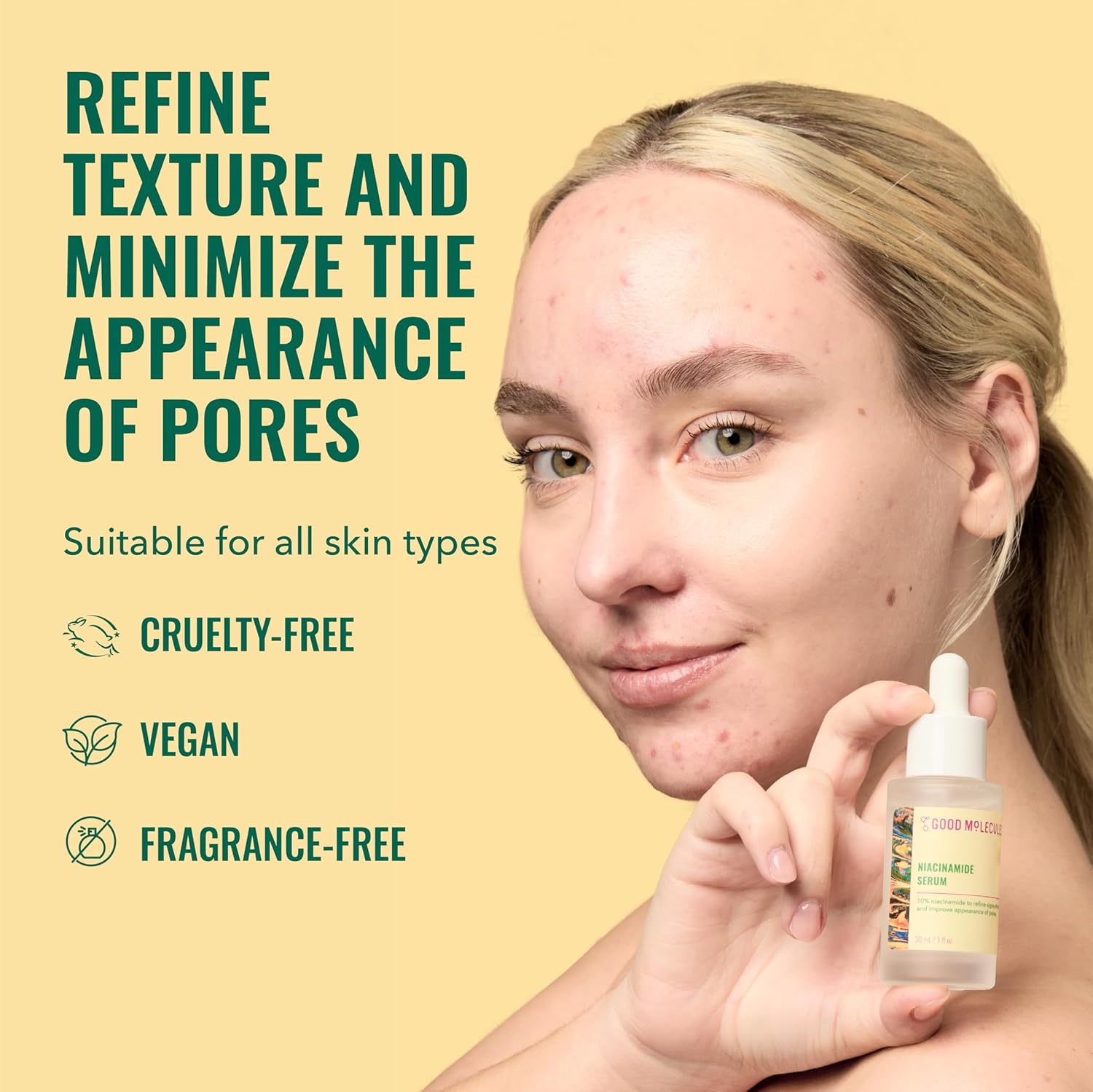
Tranexamic acid (TXA) works through a different mechanism than most brighteners — it interferes with plasminogen activation in the skin, which reduces the inflammation-driven melanin production that causes melasma and post-inflammatory hyperpigmentation. Tierney’s 2021 clinical review in the Journal of Clinical and Aesthetic Dermatology put the effective topical benchmark at 3%. The challenge: formulators are still learning how to work with TXA at scale, and the ingredient commands a slight premium. Finding it at a clinically meaningful 3% in a sub-$15 product is uncommon as of mid-2026. Good Molecules’ Discoloration Correcting Serum (which lands around $12–$15 at Ulta and the brand’s own site) is one of the notable exceptions — it leads with tranexamic acid and is transparent about its concentration positioning. If you’re building a protocol around TXA, this is the product most often cited by formulators and ingredient-literate reviewers as the budget entry point worth trusting.
Vitamin C: Almost Always Compromised at This Price Point
L-ascorbic acid at clinically meaningful concentrations (10–20%) requires precise pH management (pH 2.5–3.5), antioxidant co-factors to slow degradation (typically vitamin E and ferulic acid), and packaging that limits air and light exposure. At $15, hitting all three requirements simultaneously is nearly impossible — something gets cut. Usually it’s either the concentration (dropping to 5% or below, where the brightening evidence gets thin) or the packaging (clear glass or plastic that accelerates oxidation).
The realistic use case for vitamin C in this tier is as a supporting antioxidant, not as a primary brightening active. If a sub-$15 product markets itself primarily on vitamin C, look closely: Is it L-ascorbic acid or a derivative like ascorbyl glucoside or sodium ascorbyl phosphate? Derivatives are more stable but less studied for direct melanin suppression. Neither is bad — but the clinical evidence ladder is shorter. For serious dark-spot correction at this price point, you’ll get more reliable results pairing a budget niacinamide product with a budget exfoliant than chasing a cheap vitamin C serum.
Layering Rules for Budget Brightening Stacks
Budget brighteners work best as part of a deliberate protocol. Here’s how the major actives interact:
Niacinamide + AHA/BHA (like glycolic or salicylic acid): Generally compatible. Apply the exfoliant first, wait for full absorption (10–15 minutes), then layer niacinamide. The myth that niacinamide and vitamin C cause a reaction (forming niacin, which causes flushing) has been largely debunked at cosmetic-use concentrations, per Healthline’s review of the interaction — but if you’re using a high-pH niacinamide product directly after a low-pH vitamin C serum, you’ll blunt the vitamin C’s efficacy. Wait between applications.
Kojic acid + vitamin C: Avoid layering these without a waiting period. Both are pH-sensitive in different directions and can interact in ways that accelerate oxidation of both actives.
Tranexamic acid: TXA is one of the most broadly compatible brightening actives available. It works at or near physiological pH, doesn’t conflict with retinol, niacinamide, or AHAs, and can be used morning or evening. For someone building a budget stack from scratch, TXA-based products like Good Molecules Discoloration Correcting Serum are the most forgiving layering anchor.
Retinol + any brightener: Apply brighteners first. Retinol is the last step before moisturizer at night and should not be layered directly under occlusive or acidic products.
The Decision Rule
Here’s the if/then framework for navigating this category:
If your primary concern is post-inflammatory hyperpigmentation (acne marks, not sun damage): Lead with tranexamic acid or niacinamide at 5%+. Good Molecules Discoloration Correcting Serum is the most formulation-transparent budget entry point. Check that TXA appears in the first third of the ingredient list.
If your concern is sun-related dark spots and uneven tone: Pair a glycolic-acid product (L’Oréal Glycolic Bright range) with a standalone niacinamide serum. The exfoliation clears the path; the niacinamide targets transfer.
If you’re tempted by a vitamin C product under $15: Verify the form (L-ascorbic acid vs. derivative), verify the packaging is opaque and air-limiting, and recalibrate your expectation — treat it as antioxidant support, not primary spot correction. The clinical evidence for L-ascorbic acid at sub-10% concentrations for hyperpigmentation is thin.
If you’re building a client-facing protocol or advising a patient: The budget tier is appropriate for maintenance, for clients sensitive to higher-concentration actives, and for building foundational habits. It is not where you’ll find the vehicle technology or concentration precision needed for clinical melasma protocols — for that, the jump to SkinCeuticals Discoloration Defense ($98) or Murad Rapid Age Spot Correcting Serum ($82) is justified by formulation gap, not brand premium alone.
The budget tier rewards label literacy. Read the ingredient list. Know your thresholds. The products that respect both will show you exactly where they stand.