If you’ve ever noticed a dark spot on your cheek — maybe from an old breakout, sun exposure, or just the passage of time — and gone looking for something to fade it, you’ve probably run into a wall of unfamiliar words. Serums labeled with “TXA,” “niacinamide,” “arbutin” — it sounds clinical, but these are just the names of specific ingredients that researchers have studied for their ability to reduce excess pigmentation (the overproduction of melanin, which is the skin’s color pigment). Korean skincare brands have gotten particularly good at combining multiple of these ingredients into a single formula, rather than asking you to buy separate products for each one. This article breaks down what those ingredient combinations actually do, which Korean serums are doing it well at each price tier, and how to decide which stack makes sense for your current protocol — whether you’re building a client-facing menu or shopping for yourself.
| EDITOR'S PICK[COSRX 2% Alpha Arbutin Discolor…](https://www.amazon.com/dp/B0DGG3MMJX?tag=greenflower20-20) | Mid-tier[Anua Niacinamide 10 + TXA 4 Ser…](https://www.amazon.com/dp/B0CLLV2T1P?tag=greenflower20-20) | Budget pick[celimax The Vita A Retinal Shot…](https://www.amazon.com/dp/B0DK4Y2YP3?tag=greenflower20-20) | |
|---|---|---|---|
| Key brighteners | Alpha Arbutin 2% | TXA 4% | Retinal 0.1% |
| Niacinamide | ✓ | ✓ | — |
| Tranexamic acid | ✓ | ✓ | — |
| Size | 1.7 fl oz | 1.01 fl oz | 15 ml |
| Target concern | Dark spots | Glass skin | Anti-aging |
| Price | $25.00 | $21.85 | $18.90 |
| See on Amazon → | See on Amazon → | See on Amazon → |
Why Multi-Active Stacks Make Sense — and When They Don’t
Single-active brightening products still have their place. If you’re running a straightforward vitamin C protocol or managing retinoid-induced sensitivity, isolating variables is the right call. But for post-inflammatory hyperpigmentation (PIH — the dark marks left by acne or injury) and melasma (a hormonally influenced pigmentation pattern), the research increasingly supports attacking the pathway at multiple points simultaneously.
Here’s the logic: melanin production isn’t a single switch. Tranexamic acid (TXA) works by interrupting the signal that UV exposure and inflammation send to melanocytes (the cells that produce pigment) — specifically by blocking plasminogen activators, which are proteins that trigger melanin synthesis. Per a study published in the Journal of Research in Medical Sciences (Ebrahimi and Naeini, 2014), topical TXA at 3–5% demonstrated measurable reduction in melasma over 12 weeks.
Niacinamide (a form of vitamin B3) operates downstream — it doesn’t stop melanin from being made, it blocks the transfer of melanin from melanocytes to the surrounding skin cells (keratinocytes) that give hyperpigmentation its visible appearance. The study most frequently cited in formulation literature is Hakozaki et al., published in the British Journal of Dermatology (2002), which found that 5% niacinamide significantly reduced melanosome transfer in cell models and in a controlled human trial.
Arbutin — specifically alpha-arbutin, the more bioavailable form — inhibits tyrosinase, the enzyme that converts precursors into melanin in the first place. Research published in the Journal of Cosmetic Science (Sugimoto et al., 2004) found alpha-arbutin to be significantly more effective than beta-arbutin at equivalent concentrations, with a favorable safety profile at 1–2%.
The case for stacking: these three actives operate at different points in the melanin cascade. TXA cuts the upstream signal. Alpha-arbutin interrupts the enzymatic conversion. Niacinamide blocks the final transfer step. Used together, they address pigmentation comprehensively without the irritation risk that comes from high-concentration single-active formulas like prescription hydroquinone.
The case against: if a product is trying to do everything, it sometimes does nothing at full clinical dose. A formula listing all three actives but underdosing each one is a marketing exercise, not a clinical protocol. This is the critical read-the-label skill this article wants to build.
Minimum Effective Concentrations: The Numbers That Matter
Before evaluating any specific product, internalize these thresholds. They’re your filter.
By the numbers — minimum effective concentrations:
| Active | Minimum effective % | Notes |
|---|---|---|
| Tranexamic acid (TXA) | 3% topical | 5% preferred for melasma; oral dose studies not applicable to topical |
| Niacinamide | 5% | Studies at 2% show minimal effect; 10% delivers faster results with some flushing risk |
| Alpha-arbutin | 1% | Beta-arbutin requires ~10x higher concentration for equivalent effect |
Per the Paula’s Choice Ingredient Dictionary (paulaschoice.com), niacinamide below 5% is unlikely to deliver the melanosome-transfer inhibition seen in peer-reviewed trials. Any product that lists niacinamide in the back half of its ingredient deck — after the preservatives — is almost certainly sub-threshold.
Boo YC, writing in Antioxidants (2021), reinforces the 5% benchmark and notes that concentrations up to 10% are well-tolerated by most skin types, making the “too much niacinamide causes flushing” concern largely overstated at cosmetically realistic percentages.
Korean Serums Worth Analyzing at Each Tier
Accessible Tier ($15–$45)
Some By Mi Galactomyces Pure Vitamin C Glow Serum positions itself as a vitamin C product but the actual brightening work in its formula comes from a niacinamide and alpha-arbutin pairing alongside galactomyces ferment filtrate. Reviewers at Byrdie consistently rate this as a strong entry point for combination skin, citing its lightweight texture and absence of the oxidation instability that plagues L-ascorbic acid in this price tier. The brand’s published ingredient transparency places niacinamide in the active zone of the deck.
Cosrx The Vitamin C 23 Serum — despite the name — is frequently discussed in ingredient-literate communities alongside TXA starter products because it’s often paired with Cosrx’s separate niacinamide offerings in a deliberate split-stack approach. Worth knowing: at this tier, some Korean brands intentionally sell half of a stack as separate SKUs, which is honest but requires the consumer to do the assembly work.
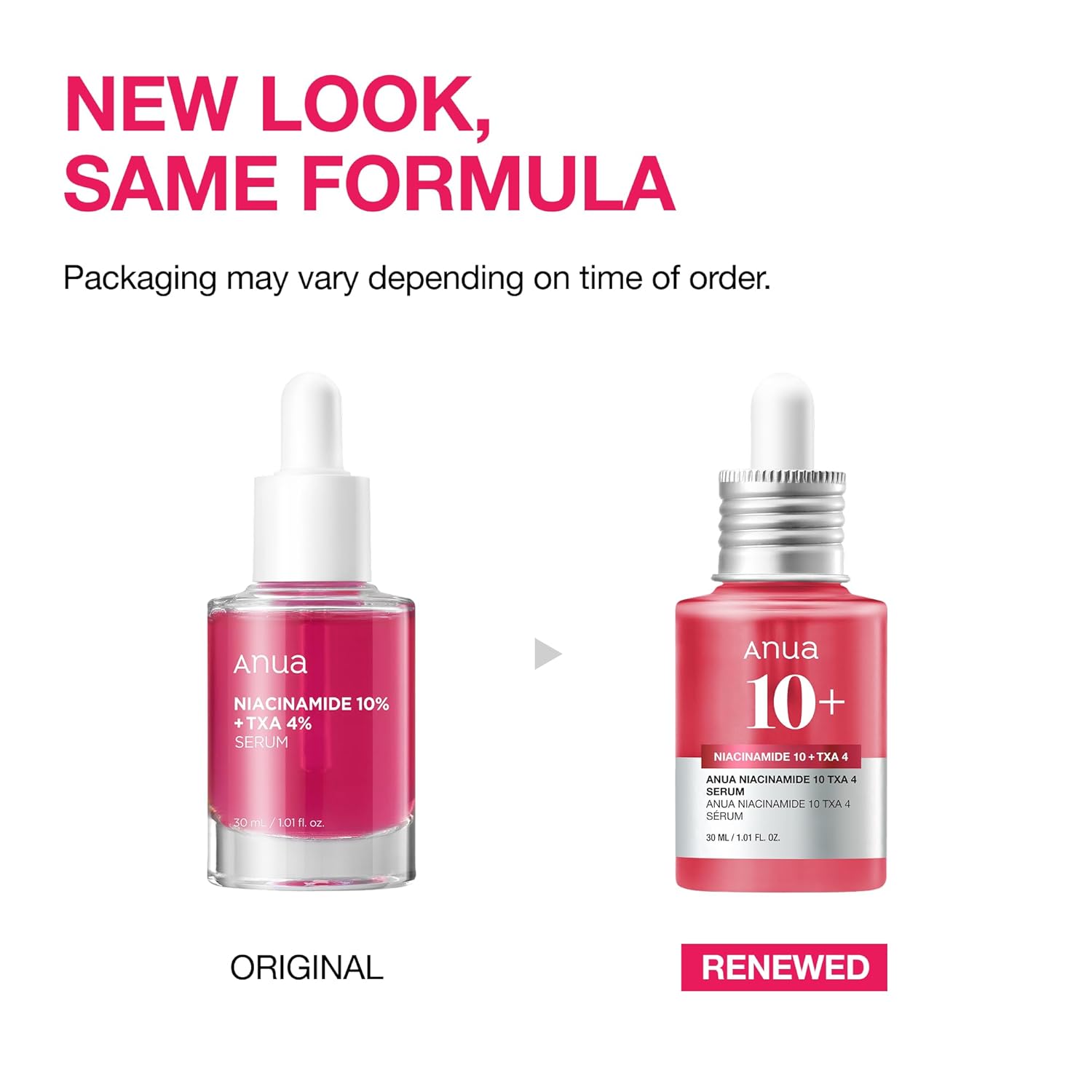
Anua Niacinamide 10% + TXA 4% Serum is the most direct single-product stack at this price range that meets both minimum concentration thresholds on two of the three actives. It’s appeared in multiple Healthline roundups of niacinamide serums (healthline.com/health/beauty-skin-care) as a value pick precisely because it publishes its percentages — which most brands avoid. The 10% niacinamide and 4% TXA combination aligns with published efficacy thresholds. If you’re advising clients on a starter brightening protocol and they have a $30–$40 budget for a single serum, this is the formula to benchmark against.
Mid-Tier ($45–$90)
Mixsoon Centella Niacinamide Serum layers 10% niacinamide with centella asiatica (a calming botanical), making it well-suited to post-procedure skin that needs brightening support without additional irritation. For aestheticians managing clients coming off a chemical peel or laser treatment, the anti-inflammatory profile matters as much as the pigmentation actives.
Beauty of Joseon Glow Serum: Propolis + Niacinamide has built a substantial following in ingredient-aware skincare communities. The propolis component functions as an anti-inflammatory, which is relevant because inflammation is itself a driver of PIH. The layering logic: address the trigger (inflammation) while simultaneously blocking melanin transfer. Published ingredient lists confirm niacinamide in the active range.
Torriden Dive-In Niacinamide Serum has begun appearing in mid-tier formulation comparisons because it stacks niacinamide with hyaluronic acid at multiple molecular weights — not a brightening active per se, but the hydration scaffolding matters for barrier-compromised skin that can’t tolerate a full actives protocol without irritation.
Prestige Tier ($90–$160)
Sulwhasoo Concentrated Ginseng Brightening Serum operates differently from the TXA/niacinamide/arbutin paradigm — its brightening mechanism relies on a proprietary ginsenoside complex rather than synthetic actives. For clients who respond to botanical-forward formulas or who have sensitivity concerns around TXA, this is the prestige-tier alternative worth knowing. The tradeoff: less published clinical evidence specific to the formula; more brand-funded efficacy data.
Laneige Radian-C Cream and Brightening Serum (the serum SKU) incorporates vitamin C alongside niacinamide in a stabilized ascorbyl glucoside form — a derivative that’s more stable than L-ascorbic acid but requires conversion to active form in skin, which reduces potency relative to pure L-ascorbic acid. Allure’s coverage of Korean brightening launches has noted this formula for its texture and layering tolerance, particularly under SPF in humid climates.
Layering Compatibility: What Stacks With These Actives
This is where practitioners most frequently make errors — not in product selection but in protocol sequencing.
TXA is broadly compatible. Unlike exfoliating acids or retinoids, it doesn’t carry significant pH interaction risks or sensitization potential when combined with niacinamide or alpha-arbutin. You can run TXA morning and evening without conflict against most other actives.
Niacinamide + L-ascorbic acid: this combination has been rehabilitated in recent formulation science. The concern about niacinamide forming a yellow-pigmented complex (nicotinic acid) with vitamin C was based on high-temperature conditions not replicated in normal skin application. At physiological skin temperatures, the interaction is negligible. Byrdie’s ingredient-interaction coverage summarizes this well — the concern is largely outdated.
Alpha-arbutin + AHAs (glycolic, lactic acid): use caution. AHAs lower skin pH, and arbutin’s enzymatic inhibition is pH-sensitive. If you’re running an AHA exfoliant in the same routine, separate them by time of day — alpha-arbutin in the morning, AHA at night.
Niacinamide + retinoids: compatible and often synergistic. Niacinamide’s anti-inflammatory properties can buffer some of the irritation associated with retinoid initiation, making this a logical pairing for clients who are new to retinoids and brightening simultaneously.
The Decision Frame
If you’re choosing between these products for yourself or a client protocol, apply this filter:
If the goal is melasma with an established routine: prioritize a product that meets the 3%+ TXA threshold. Anua’s published-percentage approach is your baseline comparison; any product claiming TXA efficacy without publishing its concentration is asking you to trust marketing over data.
If the goal is PIH from acne: niacinamide at 5–10% is your primary active. Look for it in the top half of the ingredient deck. A niacinamide + alpha-arbutin combination (without TXA) is often sufficient and avoids over-engineering the protocol.
If the patient/client is post-procedure or barrier-compromised: choose the niacinamide formula with the strongest anti-inflammatory co-actives (centella, propolis, or panthenol). Brightening on compromised skin is a slower game — pushing actives too hard on a damaged barrier causes more PIH, not less.
If budget is the constraint: the multi-active stack that publishes its percentages is always the better buy over a prestige product with proprietary blends and no disclosed concentrations, regardless of price. Transparency is itself a formulation signal.
The Korean skincare industry has produced genuinely sophisticated brightening formulas — not because of brand heritage or packaging, but because brands like Anua and Cosrx built their reputations on ingredient transparency in a market where consumers demanded it. That’s the real reason these formulas are worth your attention.