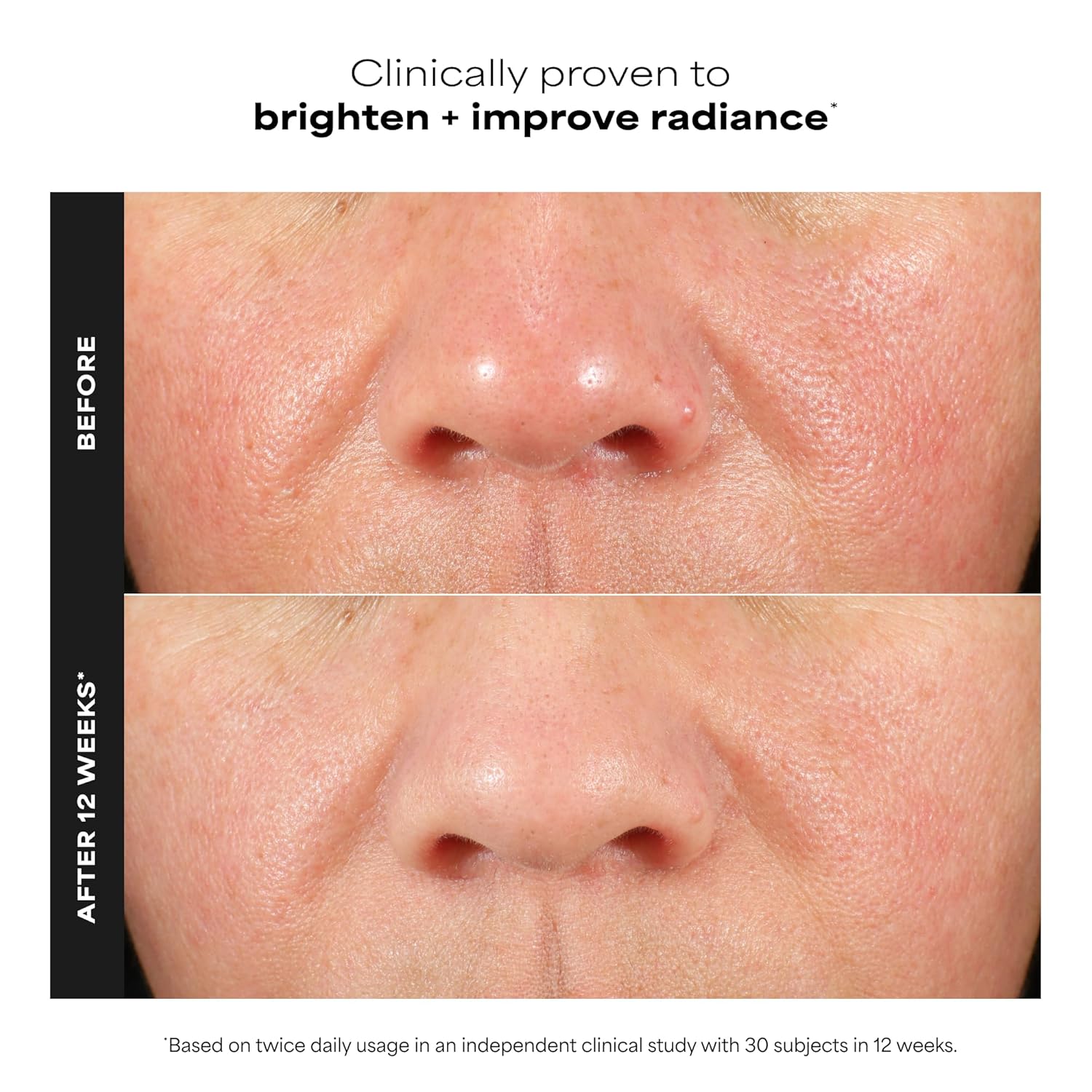
If you’ve ever noticed uneven skin tone, brown spots from sun exposure, or the kind of dullness that no amount of sleep seems to fix, you’ve probably been told to try vitamin C. In skincare, the most researched and clinically validated form of vitamin C is called L-ascorbic acid — the pure, active molecule your skin can actually use to reduce discoloration, stimulate collagen, and block some of the damage UV light causes over time. The problem is that L-ascorbic acid is notoriously finicky. It oxidizes (breaks down on contact with air and light), it only works within a narrow pH window, and it has to be present at a meaningful concentration to do anything at all. So when you’re staring at a shelf full of serums all claiming to “brighten and correct,” the real question isn’t whether they contain vitamin C — it’s whether they contain enough, in a form that’s stable enough, to actually deliver.
This guide is built for the reader who’s past the “what is vitamin C?” stage and is now making real decisions: Which product at which price point justifies the investment? Where does concentration matter, and where does formulation context matter more? What are the tradeoffs between pure L-ascorbic acid and its derivatives? By the end, you’ll have a clear decision framework — not a vague “it depends.”
| EDITOR'S PICK[Sunday Riley C.E.O. 15% Vitamin](https://www.amazon.com/dp/B074JXVVW3?tag=greenflower20-20)… | Mid-tierPaula's Choice BOOST C15 Super… | Budget pick[CeraVe Vitamin C Serum for Face](https://www.amazon.com/dp/B07PNCCLD2?tag=greenflower20-20)… | |
|---|---|---|---|
| Concentration | 15% | 15% | 10% |
| Ferulic Acid | — | ✓ | — |
| Vitamin E | — | ✓ | — |
| Hyaluronic Acid | — | — | ✓ |
| Fragrance-Free | — | ✓ | ✓ |
| Price | $50.00 | $41.25 | $23.86 |
| See on Amazon → | See on Amazon → | See on Amazon → |
The Concentration Threshold: Why Percentage Isn’t the Whole Story
Let’s start with the number every label wants you to notice: the concentration percentage.
The foundational research here is unambiguous. The 2001 Duke University study by Pinnell et al., published in Dermatologic Surgery and indexed on PubMed/NCBI, established that percutaneous absorption of L-ascorbic acid peaks between 10% and 20%, with 20% being the practical ceiling — concentrations above that don’t absorb better and may increase irritation. Below 10%, the skin’s natural antioxidant reservoir shows measurable but modest replenishment. The clinical sweet spot the study identified was 15% for photoprotection and collagen synthesis benefits.
The practical minimum is 10%. The clinical target is 15–20%. Any product below 10% is a nice-to-have, not a corrective treatment. Remember that when a label reads “with vitamin C” in small print near the bottom of the ingredient list.
But here’s where practitioners need to go further: concentration is only meaningful if the product’s pH allows the molecule to penetrate. L-ascorbic acid requires a formulation pH of 2.5 to 3.5 to remain in its active, un-ionized form at the skin surface, per the Paula’s Choice Ingredient Dictionary and corroborated by Farris (2005, Dermatologic Surgery, PubMed/NCBI). Above pH 3.5, the molecule ionizes and absorption drops sharply. Most brands don’t publish pH. That’s information asymmetry working against you — and it’s one reason prestige products with documented formulation specs earn their premium.
By the Numbers
| Concentration | Clinical Evidence | Best For |
|---|---|---|
| < 10% | Antioxidant maintenance only | Sensitive skin, beginners |
| 10–14% | Measurable brightening over 8–12 weeks | Entry-to-mid tier correction |
| 15–20% | Peak collagen + pigment correction efficacy | Active dark spot treatment |
| > 20% | No added benefit; higher irritation risk | Not recommended |
Stability: The Problem Nobody Advertises
Concentration and pH get all the attention. Stability gets none — and that’s backwards.
L-ascorbic acid oxidizes in the presence of oxygen, light, and heat. When it oxidizes, it turns yellow, then amber, then brown, and it stops working. Worse, some degradation products (particularly dehydroascorbic acid and diketogulonic acid) may actually generate free radicals in the skin rather than neutralizing them. Allure’s formulation coverage has flagged this repeatedly: a vitamin C serum that’s turned orange in its bottle isn’t just less effective — it may be counterproductive.
What stabilizes L-ascorbic acid?
-
Ferulic acid + vitamin E — The most validated combination. Research cited in Farris (2005) and formulation chemistry covered by Byrdie shows this pairing lowers the required pH for stability, doubles the photoprotective effect, and extends shelf life. This is why SkinCeuticals C E Ferulic ($182) commands its price: the patent-backed 15% L-ascorbic acid with ferulic acid and tocopherol isn’t marketing — it’s a documented formulation advantage.
-
Anhydrous (waterless) bases — No water in the formulation means no hydrolysis. Silicone or oil-based vitamin C products sacrifice some of the skin-penetration efficiency of aqueous solutions but dramatically extend shelf life and are far more forgiving of storage conditions.
-
Airless pump packaging — Not a formulation fix, but a meaningful delivery variable. Dropper bottles with wide openings are the least forgiving format for L-ascorbic acid. Airless pumps meaningfully reduce oxidation between doses.
The practitioner tradeoff: Higher-efficacy, aqueous L-ascorbic acid formulations at 15–20% are inherently less stable. You’re paying for a product that needs proper storage (cool, dark, and used within 90 days of opening) and that has a shorter effective shelf life. Derivatives like ascorbyl glucoside or sodium ascorbyl phosphate are more stable but require enzymatic conversion in the skin — and the conversion rate varies person to person, making clinical outcomes less predictable. For a client protocol where you need consistent, documented results, pure L-ascorbic acid at 15–20% in a ferulic/tocopherol base is still the gold standard.
Product-by-Product Analysis: Price, Formulation, and What You Actually Get
Drugstore Tier ($12–$30): Manage Your Expectations
Neutrogena Rapid Tone Repair and L’Oréal Glycolic Bright are representative of drugstore vitamin C plays. Both use stabilized derivatives or vitamin C in combination with other actives (glycolic acid in L’Oréal’s case) rather than L-ascorbic acid at therapeutic concentrations. The Healthline overview of vitamin C serums confirms this pattern: mass-market products typically sit at 5–10% with derivatives, optimized for stability and shelf life over clinical efficacy.
These aren’t failures — they’re correctly priced for what they do. If the goal is maintenance or a gentle introduction for a client with reactive skin, a 5–10% ascorbyl glucoside formulation at $15 is a reasonable starting point. If the goal is active dark spot correction in a defined treatment window, you’ll need to move up.
Layering note: Drugstore derivative-based formulas are generally compatible with niacinamide (the old myth that they cancel each other out has been thoroughly debunked — per Byrdie’s layering guide and Paula’s Choice Ingredient Dictionary, niacinamide and vitamin C are safe together). Avoid layering with high-concentration AHAs (glycolic, mandelic) in the same application step; the pH manipulation can destabilize L-ascorbic acid.
Mid-Tier ($30–$100): Where Formulation Quality Starts Earning Its Price
Paula’s Choice C15 Super Booster (15% L-ascorbic acid) sits in the upper mid-tier and is one of the more transparent formulations in its price range. Paula’s Choice publishes both concentration and pH, which is unusual and earns meaningful trust. Reviewers across aggregated review platforms consistently note visible tone improvement within 8–10 weeks at consistent use — a timeline consistent with the clinical literature.
Good Molecules Discoloration Correcting Serum takes a different approach: tranexamic acid as the primary corrective active, with supporting brighteners. This is a legitimate formulation strategy — tranexamic acid works through a different mechanism (interrupting melanin transfer rather than antioxidant activity) and is notably more stable. For clients where L-ascorbic acid causes sensitivity, this is a sound alternative, not a compromise.
Tatcha Violet-C Brightening Serum ($88) leads with 20% vitamin C (a blend including L-ascorbic acid and ascorbyl glucoside) and adds AHAs and bakuchiol. The blended approach moderates irritation risk at the higher concentration. It’s a thoughtfully formulated prestige-adjacent option for clients who want the 20% ceiling without the aggressive pH of a pure L-ascorbic acid formula.
Layering note: At 15–20% concentrations, don’t layer L-ascorbic acid with retinol in the same routine. Use vitamin C in the morning (it’s a natural pairing with SPF, given the photoprotective synergy) and retinol at night.
Prestige Tier ($100+): When Clinical Specs Justify the Spend
SkinCeuticals C E Ferulic ($182) is the product the rest of the category is benchmarked against. The published formulation — 15% L-ascorbic acid, 1% alpha-tocopherol, 0.5% ferulic acid, pH 2.5–3.0 — maps precisely to the Pinnell et al. research parameters. This is not coincidence; Duke University researchers were involved in its development. Aestheticians and spa directors sourcing for clinical protocols consistently cite this as the standard of care for photoaged and hyperpigmented skin. The price is high; the formulation rationale is documented.
SkinCeuticals Discoloration Defense ($98) layers tranexamic acid, kojic acid, and niacinamide — a multi-mechanism approach targeting pigmentation at different points in the melanogenesis pathway. For clients with stubborn post-inflammatory hyperpigmentation (PIH) where a single active hasn’t moved the needle, this kind of stacked formulation logic is worth the price.
La Mer Brightening Essence Intense ($385) sits in a different market segment. The “Miracle Broth” fermented seaweed complex is La Mer’s proprietary signature, and the formulation prioritizes skin barrier support and luminosity over aggressive corrective actives. It is not a direct competitor to C E Ferulic in terms of dark spot correction speed. For gift buyers or clients prioritizing a luxe daily brightening experience alongside a separate corrective treatment, it serves a distinct role.
The Decision Framework: If X, Then Y
You’ve got the data. Here’s how to apply it:
If the goal is active dark spot correction with a documented clinical timeline: Prioritize 15–20% L-ascorbic acid in a ferulic/tocopherol base (Paula’s Choice C15 or SkinCeuticals C E Ferulic depending on budget). Accept the higher maintenance burden around storage and shelf life. Pair with SPF daily — this is non-negotiable; vitamin C’s photoprotective benefit only compounds with sunscreen, not instead of it.
If the client has reactive or sensitized skin: Drop to a stabilized derivative at 10% or pair tranexamic acid (Good Molecules, SkinCeuticals Discoloration Defense) as the primary corrective active. L-ascorbic acid at therapeutic concentrations and pH will likely trigger reactivity before results appear.
If budget is the binding constraint under ~$40: Paula’s Choice C15 is the strongest mid-low option with transparent formulation specs. Set accurate expectations: visible results in 10–12 weeks with consistent daily use, not four.
If you’re building a layered clinical protocol: L-ascorbic acid (morning) + retinol (evening) + SPF 30+ (morning) remains the evidence-backed triad for photoaging and hyperpigmentation. Add niacinamide as a compatible supporting player. Avoid same-step application with high-dose AHAs.
If oxidation or packaging integrity is a concern in a professional setting: Prioritize airless pump formats and counsel clients to refrigerate after opening. A $182 bottle of C E Ferulic that’s been oxidized is worth less than a $15 drugstore derivative that’s been stored correctly.
The strongest predictor of outcomes here isn’t brand or price — it’s concentration, pH, and formulation pairing. Once you know how to read those three variables, the label tells you almost everything you need to know.