If you’ve ever picked up a serum and noticed “niacinamide” on the label — maybe in a Neutrogena product at the drugstore, or in something more expensive at Sephora — you’ve already encountered one of skincare’s most well-studied brightening ingredients. Niacinamide is a form of vitamin B3. It works inside the skin to reduce the appearance of dark spots, uneven tone, and enlarged pores, and it does this without the irritation that stronger actives like retinol or L-ascorbic acid (pure vitamin C) can sometimes cause. The catch? The percentage of niacinamide in a formula determines almost everything about what it can actually do. A 2% serum and a 10% serum are not interchangeable. This guide breaks down exactly what concentrations do what, which products hit the right thresholds at each price tier, and how to decide — clearly, with the math — which one belongs in your routine right now.
Why Concentration Is the Whole Conversation
Most brightening ingredients have a minimum effective dose — a threshold below which the evidence for efficacy is thin. Niacinamide is no different.
The landmark clinical reference here is a 2002 study by Draelos et al., published in the British Journal of Dermatology, which found that a 5% niacinamide formulation produced measurable reductions in melanosome transfer (the mechanism by which melanin moves from pigment-producing cells into skin cells, causing visible dark spots) after eight weeks of twice-daily use. That study has become the de facto benchmark for “clinically meaningful” niacinamide. The Gehring 2004 review in the Journal of Cosmetic Dermatology further characterized niacinamide’s mechanisms — including its role in building the skin’s lipid barrier, reducing sebum production, and improving surface texture — and reinforced 2–5% as the functional range for barrier support, with 5%+ as the threshold for visible pigmentation work.
Here is what that maps to practically:
By the numbers:
- 2–4%: Barrier support, sebum regulation, early texture improvement
- 5%: Minimum clinically evidenced dose for dark spot and pigmentation work (Draelos et al., 2002)
- 10%: Widely used in formulations targeting persistent hyperpigmentation and visible pore reduction; Healthline’s niacinamide overview notes this is the upper ceiling most formulators use before diminishing returns and potential flushing risk
- >10%: Rare in retail products; no strong evidence of proportionally greater efficacy; some users report transient redness
Paula’s Choice’s Ingredient Dictionary entry on niacinamide confirms this tiering and notes that concentrations under 5% are better positioned for general skin health than active correction of discoloration.
The decision frame: If your goal is correcting existing dark spots — post-inflammatory hyperpigmentation from acne, sun spots, melasma — you need at minimum 5%. If your goal is preventive maintenance, barrier health, or sebum control while you also use other actives, a 2–4% formulation can earn its place in the routine. Anything below 2% is essentially a label claim.
How to Map Concentration to Price Tier
This is where formulation analysis matters more than marketing copy. Niacinamide is an inexpensive raw ingredient — so a low price point is not automatically a signal of underdosing, and a premium price point is not automatically a signal of higher concentration. The questions that matter are: What percentage does the label disclose? What is the supporting cast of the formula? And does the price reflect proprietary delivery systems or clinical evidence, or just packaging?
The Accessible Tier ($10–$30)
At the drugstore and mass-market level, niacinamide is now ubiquitous, which is genuinely good news. The challenge is concentration transparency — many products in this tier do not disclose the exact percentage.
The L’Oréal Glycolic Bright line uses niacinamide as a secondary brightener alongside glycolic acid, but does not publicly disclose niacinamide percentage. For glycolic-plus-niacinamide combination products, Allure’s ingredient guides consistently note that the niacinamide is likely functioning as a buffer and barrier-support agent rather than the primary brightening active — meaning the glycolic acid is doing the spot-correction heavy lifting, and the niacinamide is there to offset irritation risk.
Neutrogena Rapid Tone Repair serums similarly include niacinamide, but without disclosed percentages, you cannot confirm the 5% threshold. This is a genuine limitation of the accessible tier — and the honest answer for concentration-aware shoppers is that drugstore products at this level are better evaluated on their full formula (retinol concentration, AHA level, pH) than on niacinamide dose alone.
The standout at this tier for niacinamide specificity is Good Molecules Discoloration Correcting Serum (~$12–$15 at Ulta and brand DTC). Good Molecules discloses its formula openly — the serum combines tranexamic acid, niacinamide at a disclosed concentration in the 5% range, and kojic acid. Byrdie reviewers have consistently cited this product as a top recommendation for ingredient-literate shoppers who want clinical dosing at accessible pricing. The price-to-formulation ratio here is genuinely strong.
The Mid-Tier ($30–$80)
This is where standalone niacinamide serums — formulated specifically around B3 as the hero ingredient — become more common, and where concentration disclosure is considerably more consistent.
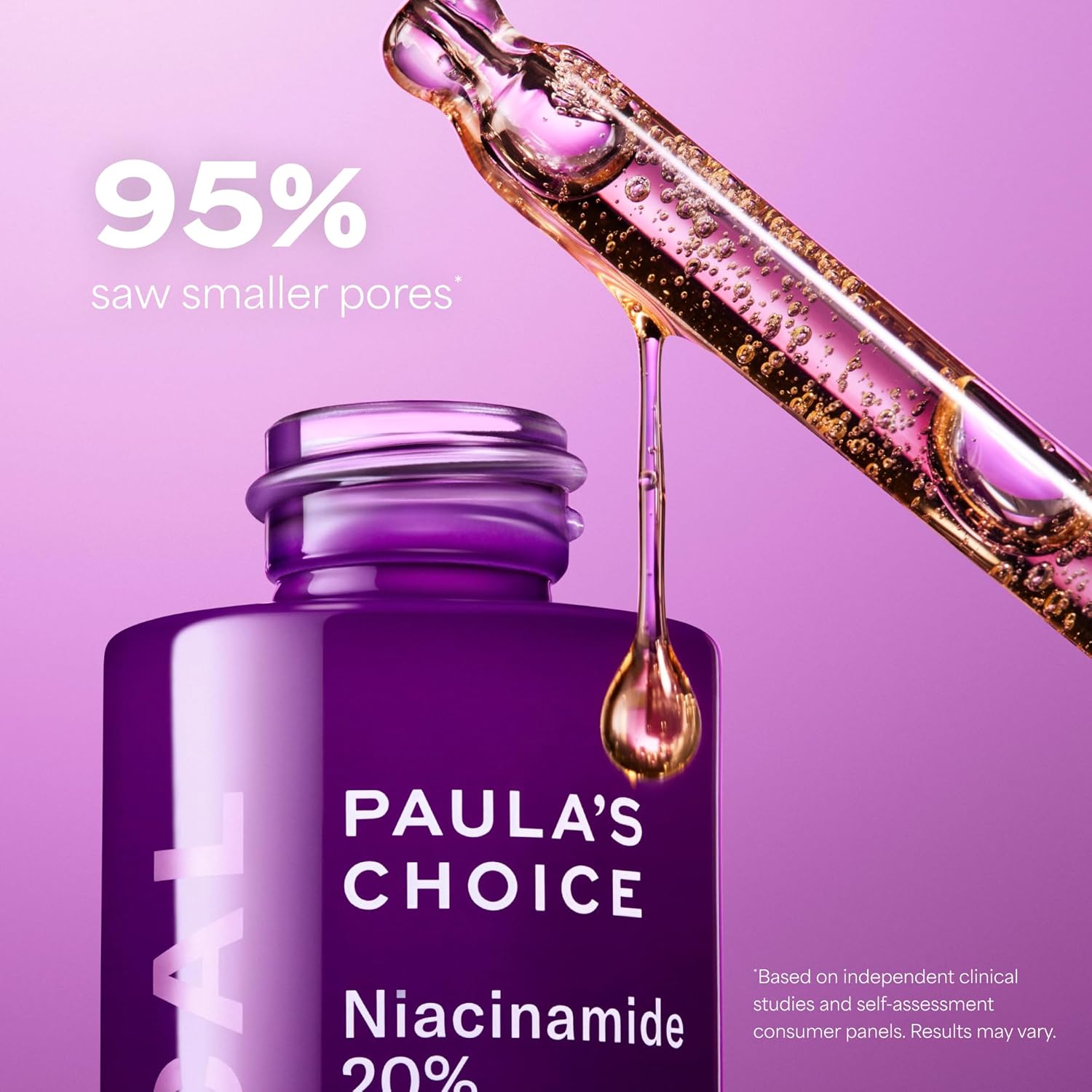
Paula’s Choice 10% Niacinamide Booster (~$49 at paulaschoice.com and authorized retailers including Dermstore) is the clearest example of what a transparent, concentration-honest mid-tier product looks like. The 10% disclosure is explicit. The supporting formula is minimal by design — it is built as a booster to be mixed into a moisturizer or layered under a serum, not as a standalone treatment. Published-spec comparisons put it at the high end of the retail concentration range, making it one of the few consumer products that genuinely reaches the 10% mark with confirmed labeling.
The tradeoff: at 10%, some users with sensitive or compromised skin report transient flushing. This is niacin-flush response — it is not allergic, and it typically resolves as the skin adapts, but it is a real consideration. The Paula’s Choice Ingredient Dictionary itself flags this and suggests starting with lower-frequency application.
The Ordinary Niacinamide 10% + Zinc 1% (~$6–$12, widely available) remains a benchmark reference point — arguably the product that normalized concentration transparency in mass-market skincare. It discloses 10% niacinamide and includes zinc PCA for sebum regulation. At its price point, the formulation is straightforward. Cosmetics and Toiletries industry analysis has noted this formula as an example of how single-active, high-disclosure serums disrupted the category’s opacity around percentages.
The Prestige and Professional Tier ($80+)
At the prestige level, the honest framing is this: you are generally not paying for higher niacinamide concentration — 10% is still the ceiling most formulators hit. You are paying for delivery systems, co-actives, and the clinical validation of a full formulation rather than a single ingredient.
SkinCeuticals Discoloration Defense (~$98 at SkinCeuticals DTC, Dermstore, and authorized physician offices) is the professional-tier benchmark. It combines tranexamic acid, kojic acid, and niacinamide in a formula designed for melasma and stubborn hyperpigmentation. The niacinamide here is not the solo active — it works as a melanosome-transfer inhibitor alongside the tranexamic acid’s broader pathway targeting. Spa directors and aestheticians recommending this product are typically doing so for clients with persistent, complex pigmentation that a single-active product has not resolved.
Tatcha Violet-C Brightening Serum (~$88 at Sephora and Tatcha DTC) uses a vitamin C complex alongside niacinamide. The formulation rationale — combining L-ascorbic acid with niacinamide for complementary brightening pathways — is supported by the Draelos research framework. A frequently asked formulation question is whether vitamin C and niacinamide can be combined without converting niacinamide to niacin (which causes flushing). Current formulation science, as summarized in the Paula’s Choice Ingredient Dictionary, indicates this conversion is not clinically significant at normal use conditions and ambient temperatures — the concern is largely historical and has been reconsidered in modern literature.
Layering Compatibility: What Niacinamide Can and Cannot Go With
This section matters for any practitioner-level routine because niacinamide is almost always a layering ingredient — not the only active.
Works well with:
- Tranexamic acid — complementary pigmentation pathways, no interaction concern
- Kojic acid — both target melanin synthesis at different points; commonly combined in professional-grade formulas
- Hyaluronic acid — no interaction; different mechanism; niacinamide can layer above or below
- Retinol / retinoids — niacinamide’s anti-inflammatory profile makes it a useful buffer in retinol routines; sequence niacinamide first (AM or PM before retinol application)
- SPF / sunscreen — no interaction; using niacinamide in the AM and applying SPF over it is standard protocol
Use with awareness:
- L-ascorbic acid (pure vitamin C) — the historical concern about niacinamide-to-niacin conversion causing flushing is considered low-risk in modern formulations, but if you are combining a pure vitamin C serum with a separate niacinamide serum, applying them in separate routines (vitamin C in AM, niacinamide in PM) is still the conservative and widely recommended approach. Allure’s ingredient guides consistently suggest this sequencing as the safe default.
- AHAs/BHAs — no chemical interaction, but layering multiple actives increases irritation risk; if using glycolic or salicylic acid, niacinamide’s barrier-support function is actually useful, but introduce one at a time
Avoid:
- No absolute incompatibilities exist in normal formulation conditions — niacinamide is one of the most stacking-friendly actives in the category, which is a meaningful part of its clinical value
The Decision Rule
If you are building or auditing a brightening protocol right now, here is the clear “if X, then Y” framework:
If your goal is dark spot correction on healthy, non-sensitive skin: Target a 5–10% product with disclosed concentration. The Good Molecules Discoloration Correcting Serum at the accessible tier and the Paula’s Choice 10% Niacinamide Booster at mid-tier both clear this threshold with label transparency.
If your goal is treating melasma or complex, persistent hyperpigmentation: A single-active niacinamide serum is unlikely to be sufficient. The SkinCeuticals Discoloration Defense — combining tranexamic acid, kojic acid, and niacinamide — is the professional-tier formulation built for this use case, and the one aestheticians and spa directors most consistently reach for in clinical protocols.
If you are optimizing a multi-active routine and niacinamide is a supporting role: A 2–5% product or a booster you can dose into a moisturizer gives you flexibility. The barrier support, sebum regulation, and anti-inflammatory function of niacinamide are worth having even when it is not the lead active.
If a label does not disclose the niacinamide percentage: That is a formulation-transparency red flag in 2026. Enough brands disclose this now that undisclosed percentages are a meaningful signal — either the concentration is below 2% (not worth paying a brightening premium for), or the brand is protecting a proprietary formula (acceptable at the prestige tier if clinical data supports the full formula, not acceptable as a standalone justification).
The math is simple: 5% is the floor for pigmentation work. Know what you’re buying before the bottle is in your cart.