You noticed a dark spot. Maybe it showed up after a breakup with sunscreen, a stubborn patch of post-acne discoloration, or years of casual sun exposure that finally called in their debt. You Googled it, landed on a product page, and saw the words “tranexamic acid” somewhere in the ingredient list. Now you want to know if it actually works — and if the product you’re eyeing contains enough of it to matter.
This article answers both questions. Tranexamic acid (abbreviated TXA) is a synthetic amino acid derivative — originally developed as a blood-clotting medication — that researchers discovered also interrupts the chain reaction that creates excess pigment (melanin) in skin. Unlike some brighteners that bleach color out, TXA blocks the signal that tells your pigment-producing cells to overproduce in the first place. It works at the source. And unlike a few of its more aggressive counterparts, it tends to do this without significant irritation — which makes it especially relevant if your skin doesn’t tolerate higher-strength vitamin C or exfoliating acids well. By the end of this piece, you’ll know exactly what concentration to look for on a label, which products across price tiers deliver it, and which tradeoffs are worth your attention.
| EDITOR'S PICK[Murad Rapid Dark Spot Correctin…](https://www.amazon.com/dp/B08KR79NBR?tag=greenflower20-20) | Mid-tier[La Roche-Posay Glycolic Acid Se…](https://www.amazon.com/dp/B005IXGA6C?tag=greenflower20-20) | Budget pick[Anua Niacinamide 10 + TXA 4 Ser…](https://www.amazon.com/dp/B0CLLV2T1P?tag=greenflower20-20) | |
|---|---|---|---|
| Tranexamic Acid | — | ✓ | ✓ |
| Niacinamide | — | — | ✓ 10% |
| Glycolic Acid | ✓ | ✓ | — |
| Kojic Acid | — | ✓ | — |
| Hyaluronic Acid | — | — | ✓ |
| Size (fl. oz.) | — | — | 1.01 |
| Price | $84.00 | $44.97 | $21.85 |
| See on Amazon → | See on Amazon → | See on Amazon → |
How Tranexamic Acid Actually Interrupts Pigmentation — and Why Concentration Is the Whole Argument
TXA works through a specific mechanism: it blocks the interaction between keratinocytes (the surface skin cells) and melanocytes (the pigment-producing cells beneath them). Under UV stress or post-inflammatory signaling, keratinocytes release a substance called plasminogen activator, which then stimulates melanocytes to ramp up melanin production. Tranexamic acid — as a plasmin inhibitor — interrupts that handoff. Per the Journal of Research in Medical Sciences (Ebrahimi and Naeini, 2014), topical TXA at 3% applied twice daily produced significant improvement in melasma (the hormonal, UV-triggered hyperpigmentation pattern) over twelve weeks, with a safety profile markedly better than hydroquinone.
That 3% figure is the clinical anchor for this entire ingredient category. A review published in Dermatologic Therapy (Taraz, Niknam, and Ehsani, 2017) confirmed that topical concentrations ranging from 2–5% showed consistent efficacy across multiple melasma trials, with the 3–5% range producing the most reliable MASI (Melasma Area and Severity Index) score reductions. Below 2%, the evidence thins. Most studies that showed meaningful results used a minimum of 2%, and many used 3%.
The practical implication: if a product doesn’t disclose its TXA percentage, you have no way to assess whether the amount present crosses the minimum effective threshold — or whether it’s a label decoration. Brands are not legally required to disclose percentage concentrations in the US, which means your first job is to find brands that do disclose.
By the numbers:
- Minimum evidence-backed topical concentration: 2% TXA
- Concentration used in most positive clinical trials: 3–5% TXA
- Typical trial duration to visible results: 8–12 weeks
- pH range for optimal stability: approximately 4.5–6.5 (per Cosmetics and Toiletries formulation reporting, 2021)
Which Products Actually Disclose Their Concentration — and Whether the Price Makes Sense
Here’s where the practitioner-level analysis gets useful. The brightening market in 2026 is flooded with TXA products. Fewer than a third of them disclose the actual percentage. The ones below do — and that transparency alone is a meaningful signal about formulation seriousness.
Good Molecules Discoloration Correcting Serum (~$12–$15) This is one of the most-cited entry points in the TXA category precisely because it discloses 3% tranexamic acid — the clinically validated threshold — in a serum retailing for well under $20. The formulation also includes niacinamide (vitamin B3, which supports barrier function and has its own published track record for post-inflammatory hyperpigmentation) and kojic acid at supporting levels. Paula’s Choice’s Ingredient Dictionary notes that this combination — TXA paired with niacinamide — is a sound brightening stack because both pathways operate differently, without competing or destabilizing each other. Reviewers at Byrdie have consistently flagged this product as an outlier for its price-to-formulation ratio. If you’re building a protocol for a client at a lower price point, or if you want a dedicated TXA step without committing to a prestige budget, this is the product the evidence points to. Layering note: Compatible with most niacinamide products, hyaluronic acid, and SPF. Use caution pairing with high-concentration L-ascorbic acid (vitamin C) at the same application step — not because TXA is unstable with it, but because both are actives and the skin’s response to two simultaneous brightening signals is less predictable. Best practice is to layer them at different times of day.
SkinCeuticals Discoloration Defense ($98) SkinCeuticals discloses 3% TXA in this formula, alongside kojic acid, niacinamide, and HEPES (a mild exfoliant). This is a multi-mechanism product: the HEPES accelerates surface cell turnover to speed up the removal of pigmented cells already at the surface, while TXA addresses new pigment formation at the root. Healthline’s overview of TXA for skin highlights SkinCeuticals Discoloration Defense as one of the few prestige products with a clearly documented active percentage and a dermatologist-recommended reputation. At $98, the price-to-formulation justification rests on the layered mechanism (four actives, each at efficacious levels) and SkinCeuticals’ documented investment in clinical testing. If you’re recommending a protocol for a client dealing with mixed melasma and post-acne hyperpigmentation simultaneously, this is the product where paying the premium is defensible — the combined mechanism handles both pigmentation types more comprehensively than a single-active approach. Layering note: Do not combine with high-dose retinoids in the same application step; the HEPES-plus-retinoid combination increases irritation risk. Layer with SPF in the morning without reservation.
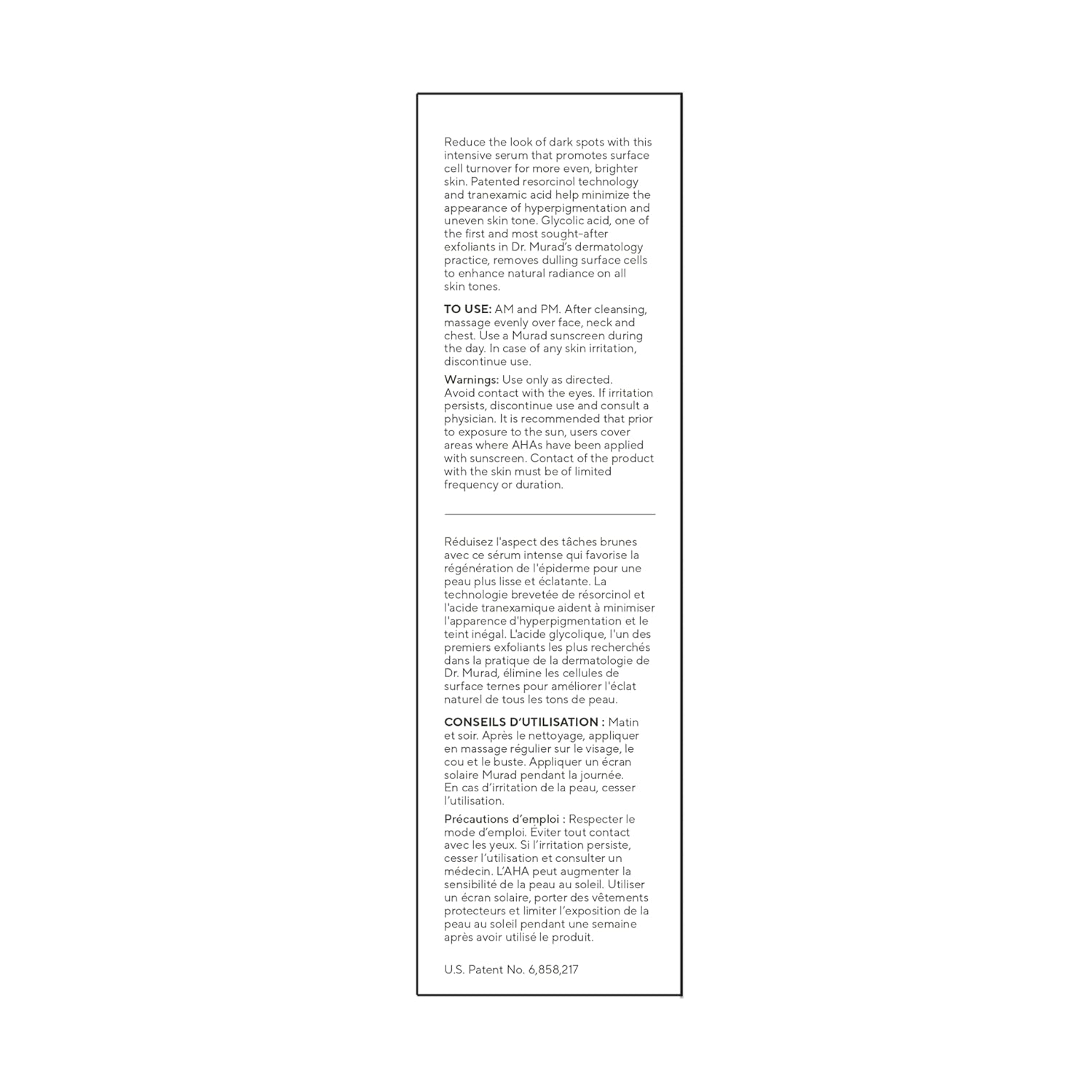
Murad Rapid Age Spot Correcting Serum ($82) Murad discloses tranexamic acid as part of its formulation but is less specific about the precise percentage than the two options above — a meaningful transparency gap. The formula also incorporates glycolic acid (an alpha-hydroxy acid, or AHA, that physically removes pigmented surface cells by loosening the bonds between them) and retinol. It’s a more aggressive multi-active approach than a TXA-only serum, which can be an advantage for certain skin types and concerns. Aggregated reviewer patterns on Dermstore, where the product is sold, note that users with thicker, less reactive skin report faster visible results — consistent with the exfoliant component accelerating turnover. For sensitive skin types, or for clients already on prescription retinoids, this formula’s ingredient density may be too high to add without overlap. Layering note: The glycolic acid in this formula means it should not be combined with other AHAs or BHAs in the same routine step. If the client is already on tretinoin (prescription retinol), do not add this without a conversation about double-retinoid load.
Paula’s Choice C15 Super Booster ($52) — A Relevant Comparison This is not primarily a TXA product — it’s a 15% L-ascorbic acid (vitamin C) booster — but it belongs in this comparison because the practitioner question is often “TXA or vitamin C, or both?” The short answer: they’re complementary, not duplicative. Vitamin C functions primarily as an antioxidant and a tyrosinase inhibitor (it disrupts a different enzyme in the melanin-production chain), while TXA targets the plasmin pathway upstream of that. Paula’s Choice’s own ingredient dictionary explicitly notes that TXA and vitamin C operate via distinct mechanisms and can be used as part of the same overall regimen, provided you stage them appropriately (typically vitamin C in the morning, TXA serum at night, or one of each at separate steps). If budget allows only one, the decision depends on skin type and primary concern: for active post-inflammatory hyperpigmentation in a more reactive skin type, TXA’s gentler mechanism usually wins. For general photodamage and premature aging, vitamin C’s antioxidant function adds value TXA alone doesn’t deliver.
The Layering and Stability Rules That Actually Matter
TXA is one of the more stable actives in the brightening category. Unlike L-ascorbic acid (which oxidizes rapidly when exposed to air and light, making packaging a serious formulation concern), tranexamic acid is stable across a relatively wide pH range and doesn’t degrade meaningfully in standard serum vehicles. Per Cosmetics and Toiletries’ formulation coverage from 2021, TXA maintains stability in both water-based and emulsion formats, which is why you see it in both lightweight serums and richer cream vehicles. This matters when you’re evaluating whether a product is worth its price: a TXA serum in an opaque pump bottle is slightly better protected than one in an open jar, but the stability gap is far less dramatic than it would be for vitamin C.
What TXA is NOT compatible with in clinical protocols:
- Do not layer with high-dose niacinamide above 10% in the same step if either is newly introduced — not because the combination is harmful, but because tracking which active is driving any purging or adjustment reaction becomes impossible.
- Avoid pairing with hydroquinone without clinical supervision. Hydroquinone is a powerful depigmenting agent; combining it with TXA is redundant at best and can increase irritation risk at certain concentrations.
- Retinoids at night and TXA at night can coexist if introduced gradually, but for clients new to retinoids, stagger the introduction by four to six weeks to establish a baseline tolerance reading.
If X, Then Y — The Decision Framework
This is where the analysis becomes a decision rule.
If your client’s primary concern is melasma or hormonally-driven hyperpigmentation, and their skin is reactive or sensitive: Start with Good Molecules Discoloration Correcting Serum (3% TXA, disclosed). It meets the minimum effective threshold at the lowest friction point. Reassess at eight weeks.
If the concern is mixed — melasma plus post-acne marks — and budget allows a prestige step: SkinCeuticals Discoloration Defense ($98) is the most defensible recommendation. The multi-mechanism formulation (TXA + kojic acid + niacinamide + HEPES) is designed for this exact mixed presentation. The price is earned by the formulation depth.
If the client wants TXA but is already running a retinoid protocol: Either Good Molecules in the morning (TXA is not photosensitizing) and retinoid at night, or a TXA cream vehicle applied before retinoid on the same night — separated by at least twenty minutes. Don’t add Murad’s formula to an existing retinoid protocol without removing one of the retinoid steps first.
If budget is constrained and the client is tempted by an undisclosed-percentage TXA product: Decline it. A product that won’t tell you the concentration is a product you can’t evaluate. The minimum effective dose exists, and “contains tranexamic acid” without a disclosed amount is not a protocol — it’s marketing.
The ingredient works. The evidence is clear and peer-reviewed. The only question is whether the product you’re evaluating actually delivers it at the concentration that makes the evidence relevant. Now you have enough to answer that question yourself.