You’ve probably heard that vitamin C is one of the best ingredients for fading dark spots and evening out skin tone. That’s true. But if you’ve ever bought a vitamin C serum only to watch it turn orange in the bottle within a few weeks — or if it stung your face on first use — you already know the problem with the most common form, called L-ascorbic acid (LAA). LAA is the purest, most researched version of vitamin C, but it’s also notoriously unstable. It oxidizes (breaks down when exposed to air and light), and it only works at a low, acidic pH that a lot of skin simply can’t tolerate. That’s where stable vitamin C derivatives come in. These are chemically modified forms of vitamin C that stay active longer on the shelf and tend to play nicer with sensitive skin. The catch: they’re not all equally effective. This guide ranks the major derivatives by how strong the clinical evidence is for each one, and what the real tradeoffs are — so you can make an informed decision rather than guessing at the label.
| EDITOR'S PICK[innisfree Green Tea Enzyme Vita…](https://www.amazon.com/dp/B0CTKYBW8X?tag=greenflower20-20) | Mid-tier[The Ordinary Ascorbyl Glucoside…](https://www.amazon.com/dp/B074NNVLCM?tag=greenflower20-20) | Budget pick[Garnier Bright Complete VITAMIN…](https://www.amazon.com/dp/B08FTQXWC7?tag=greenflower20-20) | |
|---|---|---|---|
| Vitamin C Form | — | Ascorbyl Glucoside | — |
| Concentration | — | 12% | — |
| Size | — | 1 Fl Oz | 30ml |
| Target Concerns | Brightening, Spots | Even Skin Tone, Antioxidant | — |
| Additional Actives | Green Tea Enzyme | — | — |
| Price | $25.60 | $14.80 | $9.98 |
| See on Amazon → | See on Amazon → | See on Amazon → |
Why the “Stable” Label Doesn’t Automatically Mean “Weaker”
The reflexive assumption in many skincare circles is that LAA is the gold standard and everything else is a compromise. That framing is partially accurate but increasingly outdated. The key variable isn’t just the form of vitamin C — it’s whether enough of the active compound actually reaches the dermis (the deeper skin layer where collagen is synthesized and melanin overproduction begins).
LAA’s delivery advantage is real: at a pH of 2.5–3.5 and a concentration of at least 15–20%, it penetrates efficiently, as established by Dr. Sheldon Pinnell’s foundational research published in Dermatologic Surgery (2001). But that same acidity is why a significant subset of users — especially those with compromised skin barriers, rosacea, or sensitized skin — can’t tolerate it consistently.
Stable derivatives solve the stability and pH problem by attaching LAA to a carrier molecule. The skin’s enzymes then cleave the carrier off, releasing free ascorbic acid where it’s needed. The critical question is whether that conversion is efficient enough to produce a clinically meaningful ascorbic acid concentration in the skin. For some derivatives, the answer is a confident yes. For others, the evidence is thinner than the marketing suggests.
Here’s the tradeoff matrix in brief:
| Derivative | Stability | Required % | Conversion Efficiency | Evidence Tier |
|---|---|---|---|---|
| Ascorbyl Glucoside (AA-2G) | High | 2–5% | Moderate | Strong |
| Sodium Ascorbyl Phosphate (SAP) | High | 5–10% | Good | Strong |
| Ascorbyl Tetraisopalmitate (VC-IP) | Very High | 3–5% | Good (lipid-soluble) | Moderate–Strong |
| 3-O-Ethyl Ascorbic Acid (EAA) | High | 2–3% | High | Emerging |
| Ascorbic Acid 2-Glucoside | Very High | 2% | Moderate | Moderate |
The Derivatives Worth Taking Seriously: Evidence Breakdown
Sodium Ascorbyl Phosphate (SAP): The Reliable Workhorse
SAP is the derivative with arguably the most robust clinical backing after LAA itself. It’s water-soluble, stable at neutral pH (meaning it won’t destabilize your other actives), and converts to free ascorbic acid via phosphatases naturally present in skin. Studies reviewed in the Indian Dermatology Online Journal (Telang, 2013) confirm its anti-inflammatory properties alongside the expected antioxidant and melanin-inhibiting effects. Research also shows SAP has meaningful activity against C. acnes, making it a dual-purpose ingredient for anyone managing both post-inflammatory hyperpigmentation and acne.
Minimum effective concentration: 5%, with 10% being the more clinically supported threshold.
Formulation note: because SAP is water-soluble, it layers cleanly under moisturizers and alongside niacinamide. It does not compete with tranexamic acid. Avoid layering directly with LAA in the same routine step — redundancy plus potential instability.
Where it shows up in the market: Good Molecules Vitamin C Booster Powder allows you to add SAP to your existing routine — an approach reviewed positively across aggregated skincare community discussions for letting users control concentration. In the mid-tier, look for serums listing SAP at or above 10% in the active ingredient declaration.
Ascorbyl Glucoside (AA-2G): The pH-Friendly Option for Sensitized Skin
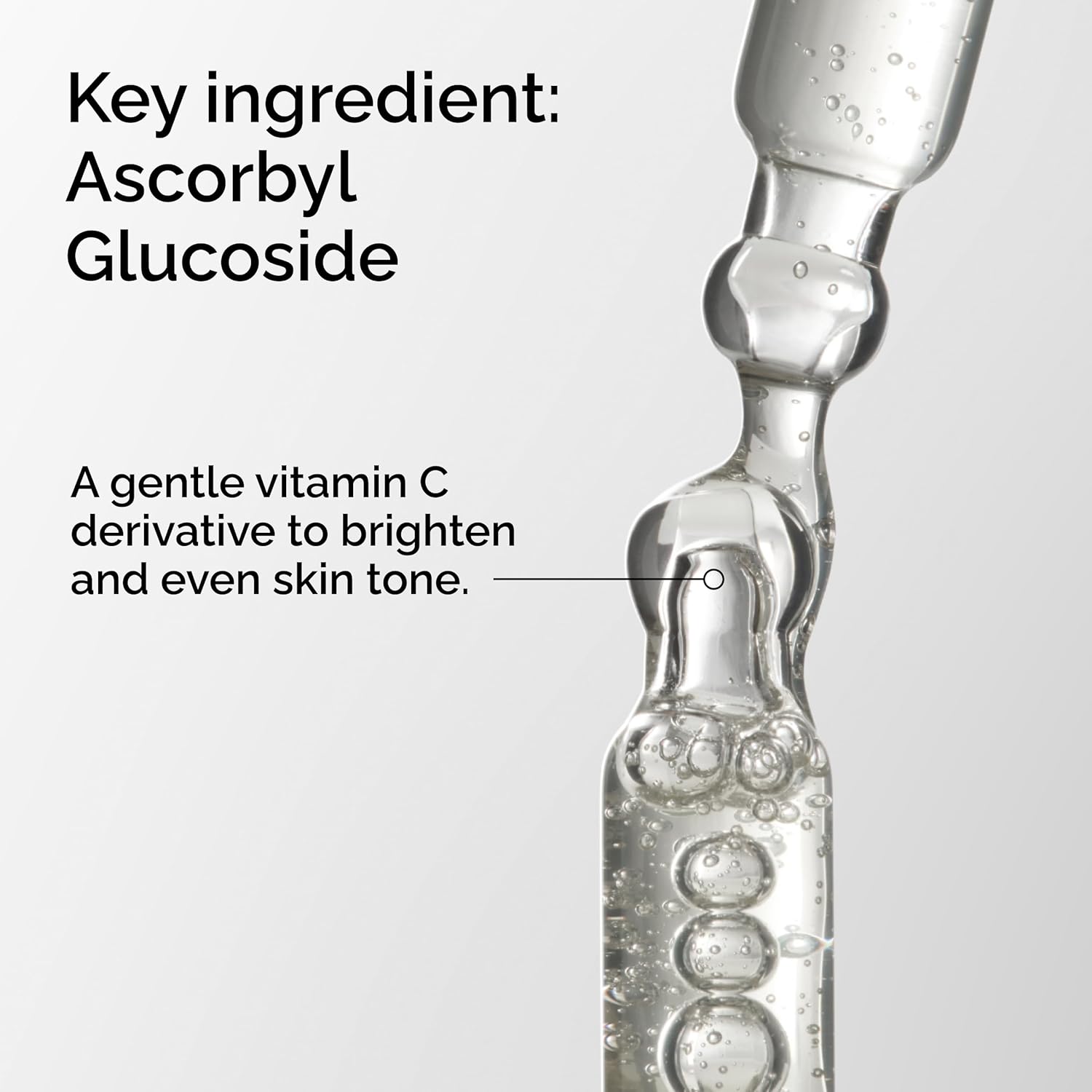
AA-2G is LAA bonded to glucose. It converts to free ascorbic acid via glucosidase enzymes in skin, and it does so at a controlled rate — which is exactly why it works well for skin that flares with harsher forms. The Paula’s Choice Ingredient Dictionary notes AA-2G’s stability across a wide pH range, which matters practically: it won’t destabilize hyaluronic acid, peptides, or barrier-repair ingredients, making it genuinely versatile for complex routines.
A 2020 study published in the Journal of Cosmetic Dermatology (Rattanawiwatpong et al.) examined a topical formulation combining vitamin C forms alongside vitamin E and ferulic acid — the same synergistic trio underlying SkinCeuticals C E Ferulic’s formulation rationale — and found statistically significant improvements in skin radiance and fine line appearance over 12 weeks. AA-2G was among the active forms assessed.
Minimum effective concentration: 2% (with 5% being more consistently cited in efficacy literature).
Layering compatibility: High. Pairs well with niacinamide, peptides, tranexamic acid, and barrier actives. One of the few vitamin C forms that doesn’t require timing separation from most other actives.
Practitioner note: If you’re recommending a protocol for a client with rosacea or a compromised barrier who wants brightening support, AA-2G is often the first pivot point away from LAA. The tradeoff: slower visible results versus LAA at optimal pH. Set realistic timelines — 8 to 12 weeks for measurable tone change.
Ascorbyl Tetraisopalmitate (VC-IP): The Oil-Soluble Wildcard
VC-IP is the fat-soluble form, which means it penetrates through lipid-rich skin layers rather than the water-based pathway. This gives it a distinct delivery advantage in formulations targeting deeper melanin correction, and it’s increasingly common in prestige-tier products where texture elegance matters. Tatcha’s Violet-C Brightening Serum, for example, uses a multi-form vitamin C approach that draws on oil-compatible derivatives to achieve both surface brightening and antioxidant protection — a layered strategy reviewed substantively in Byrdie’s ingredient analysis of the formula.
Conversion to free ascorbic acid in skin occurs via lipases, and published research suggests the conversion rate is reliable in typical skin conditions. It’s also highly stable — VC-IP does not oxidize or turn color the way LAA does, which is a formulation-quality signal worth noting on a label.
Minimum effective concentration: 3%, with 5–7% appearing in higher-performing formulations.
Compatibility: Works well in oil-in-water emulsions and anhydrous (waterless) formats. Can be combined with retinol in an evening routine more easily than water-soluble derivatives. Not ideal as a standalone treatment — most effective when combined with complementary brightening actives.
3-O-Ethyl Ascorbic Acid (EAA): The High-Efficiency Newcomer
EAA has generated significant attention in formulation chemistry circles over the past three years because it appears to convert more efficiently to free ascorbic acid than most derivatives — and at lower concentrations. A growing body of in-vitro and early clinical data supports its melanin-inhibiting activity, and it’s stable across a broad pH range.
Minimum effective concentration: 2–3%.
The honest caveat: EAA has fewer long-term, large-scale human trials compared to SAP or AA-2G. The evidence is promising but still building. Healthline’s overview of emerging vitamin C actives flags EAA as a high-interest ingredient in professional-grade formulations, while noting that the clinical depth available for LAA doesn’t yet exist for this derivative.
Decision rule for practitioners: If a client is seeking a cutting-edge brightening protocol and is willing to be an early adopter, EAA at 2–3% in a well-formulated serum is a reasonable pivot from LAA. If they need proven, peer-reviewed evidence to feel confident, SAP or AA-2G is still the more defensible recommendation.
Price-to-Evidence Mapping: Where the Tiers Actually Deliver
This is where the practitioner framing matters. Understanding which derivative you’re paying for — and whether the concentration is disclosed — is the difference between a formulation investment and a marketing spend.
By the numbers:
- SAP at 10%: commonly found in $15–$35 products; strong efficacy evidence at this concentration
- AA-2G at 5%: mid-tier ($30–$65); solid evidence, excellent compatibility
- VC-IP at 5%+: typically prestige tier ($65–$150+); evidence supports the premium mainly when combined with other actives
- EAA at 2–3%: emerging across mid and prestige tiers; premium pricing not yet fully justified by clinical data depth alone
The SkinCeuticals C E Ferulic at $182 is built around LAA — not derivatives — at a validated 15% concentration with pH optimization and ferulic acid stabilization. Its pricing reflects the LAA formulation challenge (stability, manufacturing complexity) and decades of clinical data. For clients who can tolerate LAA, that evidence base is real. For those who can’t, a well-formulated SAP or AA-2G product at a fraction of the price is not a downgrade — it’s a better match.
Paula’s Choice C15 Super Booster, also LAA-based, offers a comparable concentration at $49 with transparent ingredient labeling — a meaningful price-to-evidence value in the LAA tier.
The Decision Framework
If your goal is maximum clinical evidence and your skin tolerates it: LAA at 15–20%, pH 2.5–3.5. SkinCeuticals C E Ferulic remains the benchmark. Paula’s Choice C15 Super Booster is the defensible mid-tier alternative.
If your skin does not tolerate LAA (stinging, redness, barrier disruption): Start with SAP at 10% or AA-2G at 5%. Both have strong evidence, excellent layering compatibility, and significantly lower sensitization risk. The timeline to visible results is longer — commit to 8–12 weeks before evaluating.
If you’re building a multi-active brightening protocol for a client combining vitamin C with tranexamic acid, niacinamide, or azelaic acid: AA-2G or SAP are the cleanest pairing options. VC-IP works in an oil-phase product if you’re separating your routine by texture. Avoid mixing LAA with niacinamide in the same formula step — the interaction can produce nicotinic acid as a byproduct, which may cause flushing in sensitive skin, per the Paula’s Choice Ingredient Dictionary.
If you’re evaluating a prestige product featuring EAA: the formulation may be excellent, but price the evidence honestly with your client. You’re partly paying for innovation. That’s a legitimate choice — just not a peer-reviewed guarantee.
Stable derivatives are not a consolation prize. They are a considered formulation decision. Know what evidence tier you’re buying into, check the percentage on the label, and match the derivative to the skin barrier in front of you. That’s the whole game.